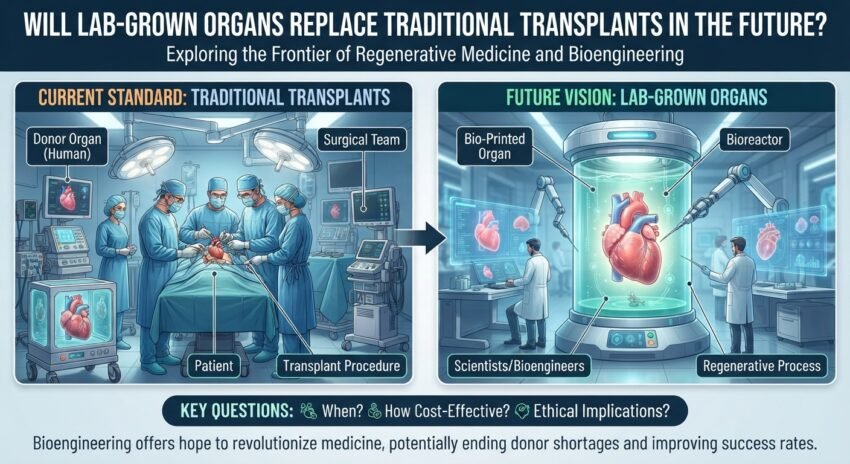
Will Organ Transplants Be Replaced in the Future by Lab-Grown Organs?
For millions of people around the world, an organ transplant can mean the difference between life and death. When the heart, kidney, liver, lungs, or another vital organ becomes severely damaged, transplantation can sometimes provide a chance for a person to live longer and regain important functions.
But modern transplantation has a major limitation: there are not enough donated organs for everyone who needs one.
Patients can spend months or years waiting for a suitable donor organ. Some become too sick to receive a transplant, while others may never find a compatible organ at all.
This shortage has encouraged scientists to investigate a remarkable alternative: growing human organs in laboratories.
The idea sounds futuristic. Instead of waiting for an organ to become available, doctors could potentially create a replacement organ specifically for a patient.
But can scientists really grow functioning human organs?
In some areas, researchers have already made important progress. Scientists can grow cells, tissues, organoids, and certain simplified biological structures in laboratories. Researchers have also developed experimental tissue-engineering techniques and investigated ways to create transplantable organs.
However, growing a complete, fully functional human organ that can safely replace a natural organ is far more complicated.
So, will lab-grown organs eventually replace traditional organ transplantation?
They could transform transplantation, but scientists still need to solve several major biological and engineering problems first.
Why Are Donor Organs So Limited?
Traditional organ transplantation depends on donated organs.
For an organ to be transplanted successfully, it generally needs to be medically suitable for the recipient. Factors such as blood type, tissue compatibility, organ size, and the patient’s medical condition can affect whether a transplant is appropriate.
Even when a patient is medically suitable for transplantation, there may simply not be an available organ.
This creates a fundamental problem.
The number of people who need organs can exceed the number of organs available for transplantation.
Scientists therefore want to develop technologies that could increase the supply.
Lab-grown organs are one possible approach.
What Does “Lab-Grown Organ” Actually Mean?
The phrase “lab-grown organ” can sound as though scientists simply place cells in a container and wait for a complete kidney or heart to appear.
Real tissue engineering is much more complicated.
Scientists need to understand how cells communicate, organize themselves, receive nutrients, form blood vessels, respond to mechanical forces, and develop into functional tissue.
An organ is not just a collection of cells.
It is a highly organized biological system.
A human kidney, for example, contains many specialized cell types arranged into complex microscopic structures. It must filter blood, regulate water and electrolytes, remove waste products, and perform other functions.
A replacement kidney therefore needs much more than kidney cells.
It needs the correct three-dimensional architecture, blood supply, connections, and biological behavior.
Where Do the Cells Come From?
One promising approach involves using a patient’s own cells.
Scientists can sometimes take mature cells from a person and reprogram them into induced pluripotent stem cells, often called iPSCs.
These cells can then potentially be guided toward different cell types.
The attraction is obvious.
If scientists could create an organ using cells derived from the patient, the resulting tissue might be more biologically compatible with that person than tissue from an unrelated donor.
This could potentially reduce certain immune-related problems.
However, matching the patient’s cells does not automatically solve every transplantation challenge.
Researchers still need to create a complete, functional organ with the correct structure and blood supply.
Why Stem Cells Are So Important
Stem cells have become one of the most important tools in regenerative medicine.
Certain stem cells can develop into specialized cell types under appropriate conditions.
Researchers can use carefully controlled laboratory environments to study how cells develop.
This has allowed scientists to produce many specialized cell types and create simplified three-dimensional structures called organoids.
Organoids can reproduce some characteristics of real organs.
For example, researchers have created organoid models resembling parts of the brain, kidney, liver, intestine, and other tissues.
These models are extremely valuable for research.
But an organoid is generally not the same thing as a complete transplantable human organ.
That distinction is important.
What Are Organoids?
Organoids are three-dimensional collections of cells grown in laboratory conditions that can reproduce some aspects of real organs.
They can help scientists study development and disease.
Researchers can also use organoids to investigate how cells respond to medicines or environmental conditions.
For example, a kidney-like organoid may reproduce some aspects of kidney development and function.
However, organoids are usually much smaller and simpler than fully developed human organs.
They may lack the complete architecture, mature blood-vessel network, or other features required for transplantation.
Scientists are working to overcome these limitations.
The Blood Vessel Problem
One of the biggest challenges in growing large organs is supplying them with blood.
Every cell inside a large organ needs access to oxygen and nutrients.
The human body solves this problem with an enormous network of blood vessels.
When scientists grow tissue in a laboratory, the outer cells may receive enough oxygen and nutrients from the surrounding environment.
But as the tissue becomes thicker, cells farther from the surface can become deprived.
This is one reason why creating large, complex organs is so difficult.
Researchers are investigating ways to create or encourage the formation of vascular networks within engineered tissues.
Without an adequate blood supply, a large artificial organ may not survive after transplantation.
Could 3D Bioprinting Solve the Problem?
Another fascinating technology is 3D bioprinting.
Traditional 3D printers deposit materials layer by layer to create physical objects.
Bioprinting uses similar principles but works with biological materials, including cells and specialized biomaterials.
In theory, scientists could use digital designs to place different types of cells in precise locations.
A future bioprinter might therefore construct complex tissue architectures according to a computer-generated blueprint.
Researchers are investigating bioprinting for tissues such as skin, cartilage, and other biological structures.
However, printing a complete functioning organ is much harder.
The printer must place different cell types accurately, create structures that remain stable, support blood-vessel development, and produce tissue capable of performing complex biological functions.
Bioprinting is promising, but it is not yet a routine method for producing replacement human organs.
Could Scientists Grow Organs Inside the Body?
Scientists are also exploring approaches that do not require building the entire organ in a laboratory.
One idea is to encourage the body to regenerate damaged tissue.
Another approach involves using biological scaffolds or implanted materials that provide a structure on which the patient’s own cells can grow.
The goal is to guide the body toward rebuilding functional tissue.
This field is part of the broader area of regenerative medicine.
Instead of replacing a damaged structure with an entirely artificial object, regenerative medicine attempts to stimulate or support the body’s own ability to repair itself.
What Is a Biological Scaffold?
A scaffold can provide a physical framework for growing cells.
Scientists can create scaffolds from natural or synthetic materials.
The structure can be designed to provide cells with places to attach and grow.
Some researchers have also investigated biological tissues that have had their original cells removed, leaving behind structural components that can potentially be repopulated with new cells.
The concept is fascinating because the natural architecture of an organ can be extremely difficult to reproduce from scratch.
Using an existing biological framework could potentially provide some of the structural information cells need.
However, the approach still faces major challenges, including repopulating the scaffold with the right cell types and establishing a functional blood supply.
The Immune System Is Another Major Challenge
The immune system protects the body by identifying and responding to foreign material.
When a person receives an organ from another individual, the recipient’s immune system can recognize the transplanted tissue as different.
This can lead to organ rejection.
Transplant patients may therefore require immunosuppressive medicines to reduce the risk of rejection.
These medications can be effective, but they also suppress parts of the immune system and can increase vulnerability to certain infections and other complications.
One major hope for lab-grown organs is that organs created from a patient’s own cells could potentially reduce immune incompatibility.
But this is an area where researchers still need extensive evidence.
Even tissues derived from a patient’s cells may present biological complexities that must be carefully studied.
Could Gene Editing Help?
Gene-editing technologies have created additional possibilities.
Researchers can modify cells with tools designed to make targeted changes to DNA.
In theory, gene editing could help scientists create cells with properties useful for regenerative medicine or transplantation.
For example, researchers could investigate ways to reduce immune recognition or correct genetic defects before creating tissue.
However, modifying human cells introduces important scientific and ethical questions.
Any changes would need to be carefully tested for unintended effects.
For transplantable tissues, safety is particularly important because the cells could remain inside a patient’s body for many years.
Growing a Heart Is Different From Growing Skin
Not all organs are equally difficult to engineer.
Skin is relatively accessible because it is thin and has a comparatively straightforward structure.
Some tissues, such as cartilage, may also be easier to engineer than complex organs.
A heart is much more complicated.
It contains specialized muscle cells, electrical conduction systems, valves, blood vessels, connective tissue, and a precise three-dimensional structure.
The organ must beat continuously and coordinate blood flow throughout the body.
A replacement heart would therefore need to reproduce a remarkable combination of mechanical, electrical, and biological functions.
Kidneys are also extremely complex because they contain intricate microscopic filtering structures and specialized transport systems.
Livers have remarkable regenerative abilities but also contain many different cell types and complex blood-flow patterns.
This means progress in one type of tissue does not automatically mean scientists can grow every type of organ.
Could Animals Help Scientists Grow Human Organs?
Another research area involves animal models and interspecies transplantation research.
Scientists have investigated whether genetically modified animals could potentially provide organs or tissues suitable for human transplantation.
This approach is different from growing an organ entirely in a laboratory, but it addresses the same basic problem: increasing the supply of transplantable organs.
Researchers are investigating genetic modifications that could make animal organs more compatible with humans.
Such research raises significant scientific, medical, ethical, and regulatory questions.
It also demonstrates how many different approaches scientists are exploring to solve the organ shortage.
How Long Until Lab-Grown Organs Are Common?
There is no reliable date when fully lab-grown replacement organs will become routine.
Scientific progress is not always predictable.
Researchers may solve one problem and discover several new ones.
A technique that works well in small laboratory tissues may behave differently when scaled to an organ large enough for transplantation.
Clinical use also requires extensive testing.
Before a new treatment becomes widely available, scientists and regulators need evidence that it is safe, effective, reproducible, and appropriate for patients.
This process can take many years.
Therefore, claims that complete lab-grown organs will become widely available in just a few years should be treated cautiously unless supported by strong clinical evidence.
What Could Happen First?
The future of regenerative medicine may arrive gradually rather than through one dramatic breakthrough.
Instead of immediately replacing entire hearts or kidneys, scientists may first develop increasingly sophisticated replacement tissues.
These could include:
- Skin
- Cartilage
- Corneal tissues
- Small tissue grafts
- Blood-vessel structures
- Specialized patches for damaged organs
- Tissue models for drug testing
As these technologies improve, researchers could move toward increasingly complex structures.
A future transplant might therefore involve a combination of traditional medicine, engineered tissue, cell therapy, and biological implants.
Could Lab-Grown Organs End the Waiting List?
This is one of the most exciting possibilities.
Imagine a future in which a patient who needs a kidney does not have to wait years for a donor.
Doctors could potentially take a small sample of the patient’s cells, reprogram and expand them, guide them into specialized tissues, and use advanced manufacturing techniques to create a replacement organ.
The organ could then be tested before transplantation.
If such a system became safe and reliable, it could fundamentally change transplantation medicine.
But this remains a future possibility rather than today’s routine clinical reality.
There are still major challenges involving organ development, blood vessels, immune compatibility, manufacturing, safety, and long-term function.
The Role of Artificial Intelligence
Artificial intelligence could also become an important part of regenerative medicine.
Creating an organ involves enormous amounts of biological information.
AI could potentially help researchers analyze how cells behave, predict useful combinations of materials, design tissue structures, or identify patterns in biological data.
Computer models could help scientists simulate how engineered tissues might respond to different conditions.
Combined with laboratory experiments, these tools could accelerate research.
However, AI would not replace biological testing.
A computer prediction is not enough to prove that a new organ is safe for a human patient.
Laboratory studies, animal research where appropriate, and carefully controlled clinical studies would still be essential.
The Future of Organ Transplantation
The future may not be a simple choice between donor organs and lab-grown organs.
Instead, medicine could use several approaches simultaneously.
Traditional donation will likely remain important.
Regenerative medicine could provide replacement tissues.
Stem-cell technologies could create specialized cells.
Bioprinting could help manufacture complex structures.
Gene editing could potentially modify cells for specific purposes.
Animal-derived organs could represent another research pathway.
Together, these technologies could gradually reduce the dependence on donated organs.
So, Will Lab-Grown Organs Replace Organ Transplants?
Probably not in the sense of completely eliminating traditional transplantation anytime soon.
But lab-grown tissues and regenerative medicine could eventually become a major part of transplantation medicine.
The most important breakthrough may not be a single technology.
It may be the ability to combine several technologies successfully.
Scientists need to understand how to control cell development, build complex three-dimensional structures, create blood-vessel networks, prevent dangerous immune reactions, and manufacture tissues consistently.
They also need to demonstrate that engineered organs can function safely for years after transplantation.
These are enormous challenges, but research is progressing across many areas.
A Future Where Replacement Organs Are Manufactured
For much of modern medical history, doctors have depended on donated organs when a patient’s vital organ fails.
The possibility of manufacturing replacement organs represents a completely different vision.
Instead of waiting for biology to provide a suitable donor organ, medicine could potentially learn to create replacement tissues on demand.
That future has not arrived yet.
But scientists are already developing many of the pieces needed to make it possible: stem-cell technology, organoids, tissue engineering, biomaterials, 3D bioprinting, regenerative medicine, gene editing, and computational biology.
The challenge is turning these individual advances into complete, safe, functional organs.
If researchers eventually solve those problems, transplantation could change dramatically.
A future patient might not simply receive an organ donated by another person.
They could potentially receive an organ grown from their own cells and designed specifically for their body.
That possibility remains a long-term scientific goal, but it represents one of the most fascinating directions in modern medicine.
The future of transplantation may therefore not be about finding more donors.
It may be about learning how to build what the human body needs.