The Hidden World of Deep-Sea Microbes: Findings from Depths Where Sunlight Never Penetrates
Introduction: Life in the Darkness of the Deep Ocean
Imagine a world where sunlight has never reached, temperatures can approach freezing in some places and exceed the boiling point of water in others, and the pressure is strong enough to crush many objects designed for life at the surface. This world exists beneath the ocean, far below the waves, where extraordinary microorganisms survive in conditions that once seemed impossible for living organisms.
The deep ocean is one of the least explored environments on Earth. Beneath its dark waters lie enormous underwater mountains, deep trenches, volcanic openings, and vast stretches of seafloor. Hidden within these environments are microscopic organisms that play essential roles in maintaining the planet’s natural systems.
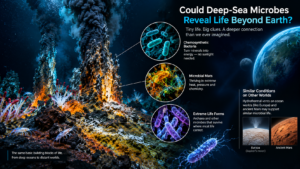
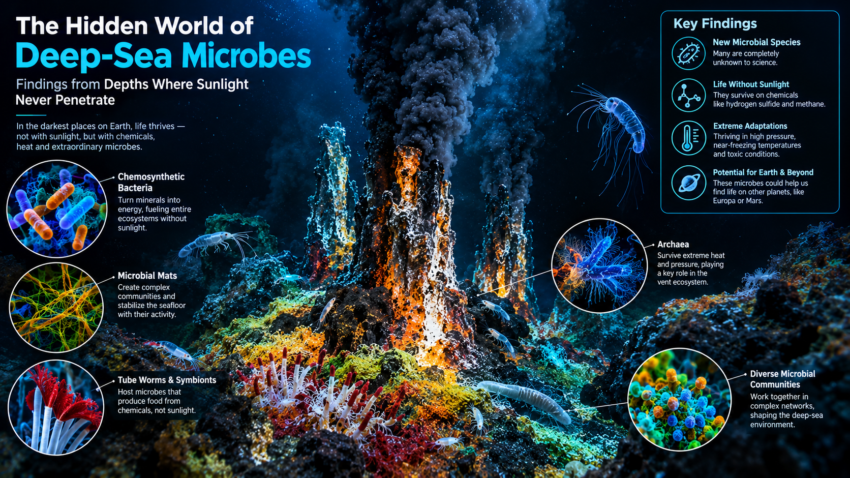
These organisms are known as deep-sea microbes. They include bacteria, archaea, and other microscopic forms of life adapted to environments with little or no sunlight. Some obtain energy from chemical reactions involving substances such as hydrogen sulfide, methane, hydrogen, or iron. Others survive by breaking down organic material that slowly sinks from the ocean’s surface.
Scientists are discovering that these tiny organisms influence much more than the immediate environments where they live. They help regulate carbon movement, transform nutrients, support unusual food webs, and contribute to the chemistry of the oceans and seafloor.
Their existence also challenges the traditional idea that life depends directly or indirectly on sunlight in every environment. Although sunlight supports most ecosystems on Earth’s surface, certain deep-sea communities rely on chemical energy instead.
By studying these hidden organisms, researchers are uncovering new information about life’s adaptability and exploring questions about whether similar organisms could exist beneath the surfaces of other worlds.
1. What Makes the Deep Sea So Extreme?
The deep sea begins below the sunlit surface waters, although scientists often use different depth boundaries depending on the environment being studied. The ocean’s deeper regions are generally cold, dark, and subject to increasing pressure.
In the open ocean, sunlight becomes extremely weak with depth. The zone where enough sunlight remains for photosynthesis is called the photic zone. Below it, photosynthesis becomes impossible because there is insufficient light for plants and algae to produce energy through this process.
At depths of around 1,000 meters and beyond, sunlight is effectively absent for biological purposes. The environment becomes almost completely dark, and organisms must depend on other energy sources.
Pressure is another major challenge. Seawater pressure increases by approximately one atmosphere for every 10 meters of depth. At 4,000 meters, the pressure is roughly 400 times the atmospheric pressure at sea level.
Such conditions can damage biological structures that are not adapted to high pressure. Deep-sea microbes, however, possess cellular systems and biochemical processes that allow many of them to function under these conditions.
Temperature varies considerably across the deep ocean. Much of the deep seafloor is close to 0–4°C, while hydrothermal vents can release fluids heated to several hundred degrees Celsius. The hottest vent fluids cannot support ordinary microbial growth at their point of discharge, but cooler surrounding areas may contain organisms adapted to high temperatures.
The availability of nutrients also differs between locations. Some regions receive organic particles from surface waters, while others depend on chemicals emerging from rocks and sediments.
These conditions create a collection of different habitats rather than one uniform environment. Each habitat supports communities of microbes with distinct survival strategies.
2. How Can Microbes Live Without Sunlight?
On the Earth’s surface, sunlight powers photosynthesis, the process through which plants, algae, and certain bacteria convert light energy into chemical energy.
In many deep-sea environments, this energy source is unavailable. Nevertheless, life can continue because some microbes use a process called chemosynthesis.
Chemosynthesis involves obtaining energy from chemical reactions rather than sunlight. Certain microorganisms use energy released when compounds such as hydrogen sulfide, hydrogen, methane, or ammonia are chemically transformed.
For example, some bacteria use hydrogen sulfide as an energy source and combine this process with carbon fixation, producing organic matter from inorganic carbon. Other microorganisms obtain energy through reactions involving methane or hydrogen.
This ability allows microbes to form the foundation of ecosystems that do not depend directly on photosynthesis.
At hydrothermal vents, seawater circulates through hot rocks beneath the seafloor. Chemical reactions between water and rock alter the composition of the fluids. When these fluids emerge, they may contain hydrogen sulfide, hydrogen, methane, and dissolved metals.
Microorganisms living around the vents use available chemicals to produce energy and organic material. Larger animals, including certain worms, mussels, and crabs, can then feed on microbial communities or form close relationships with microbes living inside their bodies.
Not every deep-sea microbe uses chemosynthesis. Many consume organic compounds produced elsewhere, including material that sinks from sunlit waters. Others participate in the decomposition of dead organisms and waste.
The important discovery is that the absence of sunlight does not automatically mean the absence of life. It means organisms must exploit different sources of energy.
3. Hydrothermal Vents: Natural Laboratories of Hidden Life
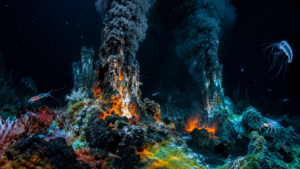
Hydrothermal vents are among the most fascinating environments in the deep ocean. They occur where seawater enters cracks in the seafloor, becomes heated by underground geological activity, and returns carrying dissolved chemicals.
Some vents form dramatic chimney-like structures as minerals precipitate from the hot fluids. These structures can resemble underwater towers surrounded by clouds of mineral-rich water.
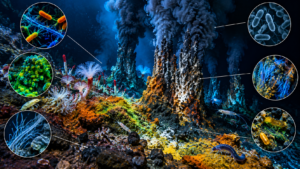
The surrounding environment can support dense communities of microorganisms. Some live freely in the water, while others form biofilms on rocks and mineral surfaces. Certain species occupy pores and cracks within the seafloor.
Conditions near vents change over very short distances. Hot, chemically rich fluids mix with cold seawater, creating gradients in temperature, oxygen availability, acidity, and chemical composition.
These gradients are especially valuable to microbes because they provide opportunities for energy-producing reactions.
Scientists have identified microorganisms that thrive at temperatures far above those tolerated by most familiar organisms. Some heat-loving archaea grow at temperatures exceeding 80°C, while certain species can survive at even higher temperatures under suitable conditions.
However, extreme heat does not mean that all vent organisms live in boiling fluids. Many occupy cooler areas where chemical energy remains available and temperatures are suitable for growth.
Hydrothermal vents have transformed scientific understanding of deep-sea ecology. They demonstrate that geological activity can create habitats capable of supporting productive biological communities far from the sunlight-driven ecosystems at the ocean surface.
They also provide natural laboratories for investigating how organisms adapt to extreme temperature, pressure, and chemical conditions.
4. The Invisible Workers of the Ocean Floor
Deep-sea microbes are not merely unusual survivors. They perform important biological and chemical functions throughout the ocean.
One of their major roles involves recycling nutrients. When organisms die, their remains may sink into deeper water or settle on the seafloor. Microorganisms break down this organic material and release nutrients that can be used by other organisms.
Without microbial decomposition, organic matter would accumulate differently, and essential elements would circulate through marine ecosystems at different rates.
Microbes also participate in the nitrogen cycle. Depending on their metabolism and environment, they can transform nitrogen-containing compounds through processes such as nitrification and denitrification. Other microorganisms contribute to nitrogen fixation, converting atmospheric nitrogen into biologically useful forms.
These transformations influence the availability of nitrogen in the ocean and affect the productivity of marine ecosystems.
Carbon cycling is equally important. Certain deep-sea microorganisms consume methane, helping prevent some of this powerful greenhouse gas from reaching the water column and potentially the atmosphere. Other microbes convert inorganic carbon into organic matter or break down carbon-rich material.
Microorganisms also influence sulfur and iron cycling, particularly around hydrothermal vents and within marine sediments.
These activities connect living organisms to geological processes. The chemistry of seawater, the composition of sediments, and the movement of elements through the ocean are all influenced by microbial metabolism.
Although individual microbes are microscopic, their combined activity across enormous areas of the seafloor can have significant environmental consequences.
5. Methane-Eating Microbes and Hidden Carbon Reservoirs
Methane is a carbon-containing gas produced through several natural processes. It can form in oxygen-poor sediments when microorganisms break down organic matter, and it can also escape from geological reservoirs beneath the seafloor.
In certain deep-sea environments, methane rises through sediments and enters the surrounding water. Scientists have discovered microbial communities capable of consuming much of this methane before it escapes into the ocean.
This process is known as anaerobic oxidation of methane when it occurs without oxygen. It commonly involves methane-consuming archaea working in partnership with bacteria that use sulfate.
During this process, methane is transformed into carbon dioxide or related dissolved carbon compounds, while sulfate is reduced to sulfide.
These microbial partnerships are especially important around methane seeps, where gas and methane-rich fluids emerge from the seafloor.
Some seeps support unusual ecosystems containing mussels, clams, and tube worms. These animals may depend on symbiotic microorganisms that obtain energy from methane or sulfide.
Methane-consuming microbes therefore act as an important biological filter in some marine environments. By consuming methane within sediments, they can limit the amount that reaches the overlying water.
Their activity also influences carbonate formation and the chemical conditions of the surrounding sediments.
Scientists are studying these organisms to understand how much methane is processed within the seafloor and how microbial activity affects the ocean’s carbon budget.
The answers matter because methane movement connects geological reservoirs, microbial ecosystems, ocean chemistry, and the global climate system.
6. Microbes Living Inside Rocks
Some of the most surprising microbial discoveries have come from the oceanic crust itself.
Beneath the seafloor lies a thick layer of rock containing cracks, pores, and fluid-filled spaces. Seawater can circulate through parts of this crust, reacting with minerals and creating chemical conditions that support microbial life.
Researchers have detected microorganisms in these environments, including bacteria and archaea that use chemical energy derived from reactions between water and rock.
For example, a geological process called serpentinization occurs when certain rocks react with water. Under appropriate conditions, this reaction can produce hydrogen and other chemical compounds that microorganisms may use as energy sources.
Microbes living within rocks face additional challenges. Nu
trients may be scarce, organic material may be limited, and access to usable energy can vary considerably.
Some deep subsurface organisms grow extremely slowly. Others appear to persist under conditions where energy availability is so low that their maintenance requirements must be minimal.
Scientists are still investigating how active these communities are, how much biomass they contain, and how organisms move through connected fractures in the crust.
The discovery of life in deep rock environments expands the known boundaries of Earth’s biosphere. It also suggests that microorganisms may occupy habitats that are difficult to detect using conventional ocean-sampling techniques.
These hidden communities may influence mineral alteration and the movement of carbon and other elements through the oceanic crust.
7. How Scientists Discover Life in Places Humans Cannot Easily Reach
Studying deep-sea microbes requires specialized equipment and careful sampling procedures.
Research vessels use remotely operated vehicles, autonomous underwater vehicles, and other instruments to investigate the seafloor. Remotely operated vehicles are connected to a ship by cables and can carry cameras, sampling devices, and scientific sensors.
These machines allow researchers to collect water, sediment, rocks, and microbial communities from locations thousands of meters beneath the surface.
Once samples reach the laboratory, scientists use several methods to investigate the organisms they contain.
DNA sequencing allows researchers to identify genetic material and compare microbial communities across different environments. Metagenomics goes further by examining genetic material collected directly from an environmental sample, allowing researchers to investigate the potential functions of organisms without growing every species in the laboratory.
Microscopy helps scientists observe cells and their relationships with minerals or other organisms. Chemical analyses reveal which compounds are present and how their concentrations change across environmental gradients.
Laboratory cultivation can provide additional information, but many deep-sea microorganisms are difficult to grow under ordinary conditions. Some require unusual temperatures, high pressure, specific chemical mixtures, or close relationships with other organisms.
For this reason, scientists often combine genetic evidence with chemical measurements and direct observations.
Detecting microbial DNA alone does not always prove that organisms are alive or actively growing. DNA may persist after cells die, and environmental samples can become contaminated during collection.
Reliable conclusions therefore depend on multiple forms of evidence, including controls, measurements of metabolic activity, and carefully documented sampling procedures.
8. What Deep-Sea Microbes Could Teach Us About Life Beyond Earth
The discovery of life in extreme environments on Earth has influenced the search for life elsewhere in the solar system.
Astrobiologists investigate whether organisms could survive in environments where sunlight is weak or absent, water availability is limited, and temperatures or chemical conditions are unusual.
Several icy worlds are particularly interesting. Jupiter’s moon Europa and Saturn’s moon Enceladus are believed to contain subsurface oceans beneath their icy surfaces. Observations of Enceladus have revealed plumes containing water and other materials originating from its interior.
Scientists have not discovered life on either world. However, these environments raise questions about whether chemical energy could support microbial ecosystems beneath the ice.
Earth’s deep-sea hydrothermal systems provide useful comparisons because they demonstrate how life can use chemical energy in darkness.
If suitable liquid water, chemical energy sources, and essential elements exist elsewhere, microorganisms might theoretically survive without sunlight. Whether the necessary conditions actually occur on another world remains uncertain.
Researchers are also interested in the chemical signatures that living organisms might produce. Certain combinations of gases or organic compounds could provide clues about biological activity, although nonbiological processes can produce many similar signals.
Studying Earth’s deep-sea microbes helps scientists distinguish potentially meaningful evidence from misleading chemical observations.
The implications extend beyond space exploration. These organisms also help researchers investigate the basic limits of life and understand which environmental conditions are essential for biological systems.
9. Can Deep-Sea Microbes Help Solve Environmental Problems?
The unusual abilities of deep-sea microorganisms have attracted interest in environmental science and biotechnology.
Some microorganisms produce enzymes that function under high temperatures, unusual chemical conditions, or elevated pressure. Such enzymes may help researchers develop industrial processes that operate under specialized conditions.
Other microbes participate in the transformation of hydrocarbons and related compounds. Scientists investigate whether these activities could contribute to the breakdown of certain pollutants, although laboratory results do not automatically translate into effective large-scale cleanup methods.
Methane-consuming microorganisms are another important research area. Understanding their activity may improve estimates of how much methane is consumed naturally in marine sediments before it reaches the atmosphere.
Researchers are also examining how microbial communities respond to changes in ocean temperature, acidity, oxygen levels, and chemical inputs.
However, deep-sea ecosystems are vulnerable to disturbance. Deep-sea mining, pollution, and poorly managed industrial activities could damage habitats that recover slowly. Some microbial communities may depend on geological conditions that take thousands of years to develop.
Potential applications should therefore be balanced against the need to protect these environments.
The goal is not simply to extract useful organisms or chemicals from the deep sea. It is also to understand how these systems function and preserve the natural processes they support.
10. The Unanswered Questions Beneath the Waves
Despite major scientific advances, much of the deep ocean remains poorly explored.
Scientists still need to determine how microbial communities differ across deep trenches, hydrothermal vents, methane seeps, and buried rock formations.
They are investigating how organisms survive when energy supplies are extremely limited and how long some deep subsurface populations can remain viable.
Another major question concerns the total contribution of deep-sea microbes to global carbon and nutrient cycles. Researchers have established that these organisms influence important chemical processes, but estimating their activity across the entire ocean remains challenging.
Climate change adds further uncertainty. Warming surface waters, changing ocean circulation, and declining oxygen levels in some regions can alter the materials reaching deep environments. The long-term consequences for microbial communities are not yet fully understood.
Improved exploration technologies, advanced DNA analysis, and more accurate chemical measurements will help address these questions.
Future research may identify organisms with previously unknown metabolisms or reveal that familiar microbial groups perform unexpected functions in particular environments.
Each discovery will contribute to a more complete picture of the ocean as a connected biological and geological system.