The Hidden World Beneath Earth’s Crust: A Discovery That Could Change the Way We Understand the Planet
Introduction:
A Mystery Concealed Beneath Our Feet
Each day, we traverse the Earth’s surface without giving a thought to the remarkable world concealed below it. Mountains tower above us, oceans extend across the horizon, and forests span vast stretches of land. Yet beneath these familiar landscapes lies a mysterious realm that scientists still find difficult to understand fully.
The Earth might seem solid and stable, but its interior is continually changing. Intense heat, immense pressure, shifting rocks, and chemical reactions shape the planet from deep within. Several of the most intriguing discoveries in modern geology indicate that the hidden interior may hold vast amounts of water trapped within minerals, as well as unusual materials that could uncover secrets about how the planet formed.
One of the most remarkable findings concerns a mineral called ringwoodite, which provides evidence that substantial amounts of water may exist hundreds of kilometers beneath the surface. This discovery has changed how researchers think about Earth’s water cycle, the movement of tectonic plates, and the forces responsible for volcanic activity.
Scientists are also investigating whether the deepest parts of the planet contain additional reservoirs of water-bearing minerals. These discoveries do not mean that researchers have found an underground ocean filled with ordinary liquid water. Instead, they point toward a complex hidden world in which water can be stored within the structure of solid rock.
Understanding this world could help answer one of the most important questions in Earth science: How much do we really know about the planet beneath our feet?
1. What Lies Beneath the Earth’s Crust?
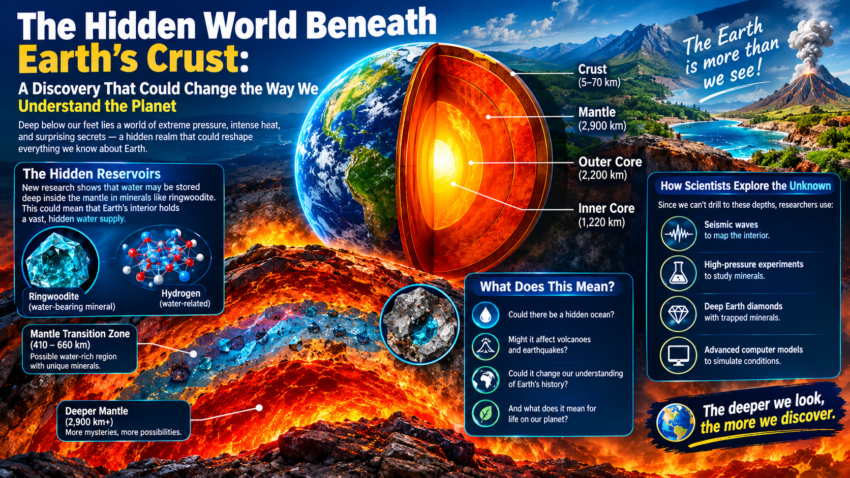
The Earth’s interior consists of several major layers, each with its own physical properties and chemical composition. Although scientists cannot directly explore most of these regions, they have developed detailed models using earthquakes, laboratory experiments, and measurements of Earth’s gravity and magnetic field.
The outermost layer is the crust, a relatively thin shell compared with the planet’s total size. Continental crust supports mountains, plains, and cities, while oceanic crust forms much of the seafloor. Its thickness varies considerably, reaching several tens of kilometers beneath many continents and becoming much thinner beneath some ocean basins.
Below the crust lies the mantle, an enormous layer of hot, mostly solid rock extending to a depth of approximately 2,900 kilometers. Despite its solid appearance, mantle rock can deform and flow very slowly over geological timescales. This movement helps drive plate tectonics, the process responsible for continental movement, mountain formation, and many earthquakes.
Farther down is the outer core, which consists mainly of liquid iron and nickel. The movement of electrically conducting material in this region generates Earth’s magnetic field. At the center lies the inner core, a solid region composed predominantly of iron and nickel under tremendous pressure.
The most surprising discoveries often concern the mantle. It occupies most of Earth’s volume, yet scientists cannot directly collect ordinary samples from its deepest regions.
Instead, they examine seismic waves, study minerals carried upward by volcanic eruptions, and reproduce deep-Earth conditions in specialized laboratories. These methods have revealed that the interior is far more complicated than a simple arrangement of hot rock surrounding a metallic core.
2. The Finding of Water Far Beneath the Earth’s Surface
For many generations, people have linked water with oceans, rivers, lakes, glaciers, and aquifers beneath the ground. Researchers now understand that Earth’s water cycle reaches well past these well-known reservoirs.In 2014, researchers reported an important discovery involving a tiny sample of ringwoodite trapped inside a diamond originating from deep within the Earth. The diamond had traveled upward from the mantle, carrying a microscopic mineral inclusion that preserved evidence of the extreme environment where it formed.
Ringwoodite is a high-pressure form of a mineral related to olivine, a common component of Earth’s mantle. Under the immense pressure found deep underground, olivine transforms into different crystal structures. Ringwoodite is stable within a region known as the mantle transition zone, approximately 410 to 660 kilometers beneath Earth’s surface.
The researchers found that the ringwoodite contained a significant amount of water-related hydrogen within its crystal structure. The sample provided direct evidence that at least some parts of the transition zone contain substantial quantities of water.
This finding supported earlier predictions based on high-pressure experiments. Scientists had suspected that minerals in this region could store water even though the surrounding environment is extremely hot.
The discovery was important because it revealed that water does not always need to exist as a separate liquid. Under deep-Earth conditions, hydrogen and oxygen can be incorporated into minerals, allowing water-related components to remain trapped within solid rock.
The discovery did not prove that the entire mantle contains the same amount of water. However, it provided an important clue about a potentially enormous reservoir that had previously been difficult to investigate directly.
3. Could There Be an Ocean Hidden Inside the Mantle?
The possibility of an immense water reservoir beneath Earth’s surface has captured scientific and public attention. Some estimates suggest that the mantle transition zone could store an amount of water comparable to one or several of the oceans at Earth’s surface.
However, this comparison requires careful explanation.
The hidden water is not necessarily gathered into a giant underground lake. Much of it may be chemically incorporated into minerals distributed throughout vast quantities of rock. These minerals can accommodate hydrogen and hydroxyl groups within their crystal structures.
Two minerals are particularly important in this discussion: wadsleyite and ringwoodite. Both can accommodate significant quantities of water-related components under suitable pressure and temperature conditions.
Laboratory experiments indicate that these minerals can potentially hold around one to several percent of their weight in water under certain conditions. If large volumes of mantle rock contain even modest concentrations, the total amount of stored water could be enormous.
Nevertheless, the storage capacity of a mineral is not the same as the actual amount of water present in the Earth. Scientists still need to determine how much of the transition zone is hydrated, how water concentrations vary between regions, and how water moves between different layers.
Research suggests that the distribution is uneven. Some areas may contain relatively little water, while others could be much richer.
Consequently, describing the mantle as a hidden ocean is a useful way to communicate the potential scale of the discovery, but it should not be interpreted as evidence for a conventional underground sea.
The real discovery may be even more interesting: Earth’s solid interior could function as a vast chemical reservoir that stores and releases water over millions or billions of years.
4. How Scientists Investigate a World They Cannot Visit
Exploring Earth’s deep interior is one of the greatest challenges in modern science. The deepest human-made boreholes reach only a tiny distance into the crust compared with the thousands of kilometers separating the surface from the core.
At greater depths, temperatures and pressures become far too extreme for ordinary drilling equipment. Scientists therefore depend on indirect evidence and carefully designed experiments.
One of their most powerful tools is seismology, the study of waves generated by earthquakes and other sources of ground motion.
When an earthquake occurs, seismic waves travel through the planet. Their speed and direction change depending on the density, temperature, composition, and physical state of the materials they encounter. By recording these waves at stations around the world, researchers can reconstruct images of Earth’s interior.
Some seismic waves travel faster through certain materials, while others slow down or change direction when they encounter unusual structures. These variations can reveal boundaries between layers and sometimes indicate the presence of partially molten rock.
Another important method involves high-pressure laboratory experiments. Researchers place tiny mineral samples inside specialized devices, compressing them to pressures comparable to those deep underground. They then heat the samples and use advanced instruments to study changes in their structure.
Scientists can also analyze diamonds containing minerals formed deep inside the mantle. Diamonds sometimes preserve tiny inclusions that would otherwise transform when exposed to surface conditions.
Together, these methods allow researchers to investigate regions that no human has ever visited. Each new measurement adds another piece to the puzzle, helping scientists distinguish established facts from promising but unconfirmed explanations.
5. The Hidden Water Cycle That Connects Earth’s Surface to Its Interior
Water constantly moves across Earth’s surface through evaporation, condensation, rainfall, rivers, and groundwater. However, a much slower cycle also connects the surface to the deep mantle.
This process begins in part at tectonic plate boundaries. When an oceanic plate moves beneath another plate, it carries water-bearing minerals, sediments, and altered oceanic crust into Earth’s interior. This process is known as subduction.
As the descending plate encounters increasing pressure and temperature, some of its minerals release water. Other minerals can carry water much deeper before eventually releasing it under different conditions.
Water entering the mantle can influence how rocks behave. It may reduce the temperature at which certain rocks begin to melt, change their strength, and affect the movement of material within the planet.
Some water eventually returns to the surface through volcanic activity and other geological processes. Volcanoes release water vapor alongside gases such as carbon dioxide and sulfur compounds. Over geological timescales, this exchange helps regulate the distribution of water between Earth’s surface and interior.
The discovery of water-bearing ringwoodite suggests that the transition zone may be an important storage region within this cycle.
If water accumulates there, it may influence how material crosses the boundary between the upper and lower mantle. If it is released, it may promote partial melting and alter the surrounding rocks.
Scientists are still investigating how much water enters, remains within, or leaves this region. The process is likely to vary across different tectonic settings.
Understanding this deep cycle could improve our knowledge of how Earth’s oceans developed and how the planet has maintained conditions suitable for life.
6. Could Hidden Water Change Our Understanding of Volcanoes and Earthquakes?
The presence of water deep inside the Earth has consequences far beyond the question of where the planet stores its moisture.
Water can influence the mechanical properties of rocks. Under certain conditions, even small amounts of hydrogen within minerals can make solid rock deform more easily. This process, often called hydrolytic weakening, affects how material responds to stress.
Such effects matter because mantle rocks are involved in the slow movements that drive plate tectonics. Changes in their strength and melting behavior can influence how material circulates inside the planet.
Water also affects the generation of magma. When water-bearing minerals release water into hot rock, the added water can lower the melting temperature of some mineral mixtures. Partial melting may then occur under conditions where relatively dry rock would remain solid.
The resulting magma can rise toward the surface and contribute to volcanic activity.
However, the connection is not as simple as saying that more water deep underground automatically produces more volcanoes or earthquakes. Volcanic eruptions depend on several interacting factors, including temperature, rock composition, tectonic setting, magma movement, and pressure.
Earthquakes are similarly complex. Many occur when stress builds along faults and rocks suddenly slip. Water can affect fault behavior in some settings, but the influence of deep-mantle water on a particular earthquake is difficult to establish.
The important point is that hidden water is not merely a passive substance stored inside rocks. It can help shape the physical and chemical processes that keep our planet active.
7. What Could Be Hiding Near the Boundary of the Mantle and Core?
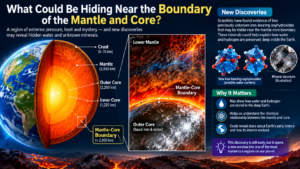
The mantle transition zone is not the only region attracting scientific interest. Researchers are also studying the deepest mantle, particularly the boundary between the mantle and the metallic core, approximately 2,900 kilometers below the surface.
Conditions there are extreme. Temperatures are very high, pressures are enormous, and materials behave differently from those found near the surface.
Scientists have investigated whether hydrogen and oxygen can become incorporated into minerals under these conditions. They are also examining how material from Earth’s earliest history may have survived in the deep interior.
In September 2026, researchers at ETH Zurich reported experimental work identifying two previously unknown iron-bearing oxyhydroxides that may be stable under conditions near the mantle-core boundary. The findings suggest a possible mechanism through which water-related components could be preserved deep inside the planet.
These results offer a promising direction for future research, but they do not establish the size of any deep reservoir or prove that these minerals occur widely in the natural Earth.
If such minerals are present in significant quantities, they could help scientists understand how water was distributed during the planet’s early formation and how hydrogen and oxygen have moved through Earth’s interior over billions of years.
This research also raises broader questions about the chemical relationship between the mantle and the core.
Earth formed from material that underwent extensive heating and differentiation. As dense metallic components moved inward and lighter silicate materials formed the mantle, different elements became distributed between distinct regions.
The present-day distribution of hydrogen and oxygen may preserve clues about those ancient processes. Studying deep-Earth minerals could therefore reveal not only where water exists today but also how Earth’s interior evolved.
8. Why These Discoveries Matter for the History of Earth
Earth formed approximately 4.54 billion years ago from material orbiting the young Sun. During its early history, the planet experienced intense heating, impacts, melting, and chemical separation.
The origin of Earth’s water remains an active area of research. Some water-bearing material may have been incorporated into the planet during its formation, while additional water may have arrived through impacts involving water-rich asteroids and other bodies.
The relative contributions of these sources are still being investigated.
Deep-Earth discoveries could help scientists reconstruct this history. If substantial quantities of water have remained trapped within minerals since the planet’s early formation, the mantle may preserve evidence of conditions that existed long before modern oceans and continents developed.
At the same time, subduction continually transfers water from the surface into the interior. This means that today’s mantle contains material influenced by both ancient planetary formation and more recent geological recycling.
By measuring the chemical composition of mantle-derived rocks, studying minerals enclosed in diamonds, and comparing observations with laboratory experiments, researchers can investigate how these processes have changed over time.
The answers could also improve our understanding of why Earth became a habitable planet.
Water plays an essential role in many geological processes that help shape the surface environment. The long-term interaction between the mantle, atmosphere, oceans, and crust has influenced Earth’s climate and chemical evolution.
Although deep water alone cannot explain the emergence or persistence of life, understanding its movement may clarify how the planet maintains its active geological systems over immense periods.
9. The Biggest Questions Scientists Still Need to Answer
Despite significant progress, many mysteries remain unresolved.
First, scientists need better estimates of the total amount of water stored in Earth’s interior. Mineral samples provide valuable evidence, but a small number of samples cannot reveal the average composition of an entire mantle region.
Second, researchers must determine how water is distributed at different depths. The transition zone may contain water-rich areas alongside relatively dry regions, making global estimates challenging.
Third, the movement of water between the upper mantle, transition zone, lower mantle, and core remains incompletely understood. Different minerals have different capacities to store hydrogen, and changes in pressure and temperature can cause water to be released or absorbed.
Fourth, researchers must investigate how these hidden reservoirs influence large-scale mantle circulation, volcanism, and the evolution of Earth’s surface.
Finally, scientists need to distinguish between laboratory possibilities and conditions that actually occur in nature. A mineral that can form under extreme pressure does not necessarily exist everywhere at the depth where it is theoretically stable.
Answering these questions will require improved seismic imaging, more sophisticated laboratory equipment, better computer models, and additional samples from deep geological environments.
Future discoveries may refine current estimates substantially. Some proposed explanations may be confirmed, while others may need revision as new evidence becomes available.
That uncertainty is not a weakness of science. It is part of the process through which researchers build increasingly accurate explanations of the natural world.