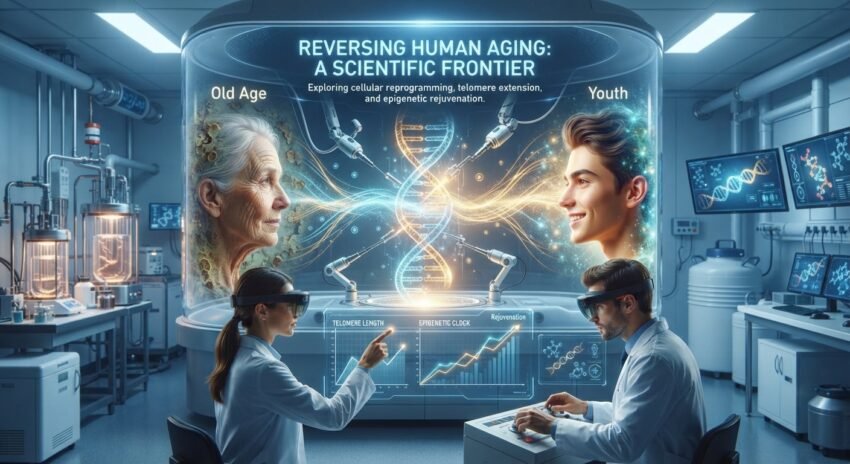
Is it possible for scientists to reverse human aging in the future?
One of the most familiar aspects of being human is growing older. Our skin changes, our muscles deteriorate, our recuperation slows down, and we are more susceptible to illnesses like cancer, heart disease, diabetes, and dementia as we age.
For centuries, people have searched for ways to slow aging or extend life. Ancient legends told stories of magical fountains and mysterious medicines that could restore youth. Today, scientists are approaching the same question from a completely different direction: Can the biological processes of aging actually be changed?
Modern research suggests that aging is not simply a clock counting upward. It is a complicated collection of biological changes involving cells, DNA, proteins, metabolism, the immune system, and the body’s ability to repair damage.
That raises a fascinating possibility.
Could scientists eventually heal some of the damage and make old cells act more like youthful cells if they can figure out why our cells age?
We don’t yet know the solution. Although scientists have found a number of intriguing methods to affect biological aging in animals and individual cells, it is still very difficult to reverse aging in the human body as a whole.
So, could humans one day become biologically younger?
Let’s explore what scientists are discovering.
What Actually Causes Human Aging?
Aging does not have a single cause.
Rather, scientists view aging as a web of interrelated biological processes. As we age, cells build up damage, cell-to-cell communication shifts, tissues gradually lose their capacity to regenerate effectively, and the body’s systems grow less resilient.
DNA damage is one significant factor.
The instructions that enable cells to function are contained in our DNA. DNA has to be copied each time cells divide. External factors like radiation, chemicals, and oxidative stress can harm DNA as well.
Luckily, cells possess repair systems that correct a large portion of this damage.
These systems, however, are imperfect.
Damage can build up over the course of decades. Alterations in DNA and gene regulation can ultimately influence how cells operate.
When telomeres become critically short, cells can enter a state called cellular senescence.
Senescent cells stop dividing, but they do not necessarily disappear. Some release inflammatory signals that can influence surrounding tissues.
This is one reason researchers are interested in finding ways to control or remove harmful senescent cells.
The Role of Senescent Cells
Imagine a city filled with old buildings.
Most old buildings might still be useful, but some could become damaged, abandoned, or dangerous. If too many deteriorating buildings remain, they can affect the surrounding neighborhood.
Something somewhat similar can happen with senescent cells.
These cells are not necessarily harmful at all times. In fact, cellular senescence serves as a crucial biological defense mechanism. It can stop damaged cells from dividing without control.
The issue can emerge once senescent cells build up in large numbers as we age.
Researchers are exploring drugs and other methods known as senolytics, which are intended to selectively clear away certain senescent cells.
Studies in animals have yielded intriguing results, such as improvements in some conditions linked to aging. Yet turning these findings into safe and effective treatments for healthy people is far more complex.
Scientists still have to figure out which senescent cells ought to be removed, at what point they should be removed, and whether their removal might cause unforeseen problems.
This highlights a key point regarding aging research:
Altering a single aging mechanism does not automatically undo the whole aging process.
Can Scientists Reprogram Old Cells?
One of the most compelling concepts in aging research centers on what is known as cellular reprogramming.
Our cells hold essentially the same DNA, yet different cells act in different ways. A skin cell acts like a skin cell, whereas a nerve cell acts like a nerve cell.
Scientists found that particular combinations of molecular factors can transform a cell’s identity in dramatic ways.
This gave rise to induced pluripotent stem cells, or iPSCs.
Researchers are able to take mature cells and reprogram them back into a more primitive, stem-cell-like state.
What is fascinating is that reprogramming can also reset certain biological traits tied to cellular aging.
This has prompted researchers to examine whether cells could be partially reprogrammed instead of fully reset.
The aim would be to make an older cell biologically younger while still letting it keep its original identity.
Theoretically, that could be immensely powerful.
Picture taking a skin cell that has aged and bringing back some of its youthful traits without converting it into an entirely different kind of cell.
Scientists have studied variations of