Could Scientists Create Artificial Blood for Humans?
Blood is one of the most important substances in the human body.
Every second, our blood moves through thousands of kilometers of blood vessels, delivering oxygen and nutrients while carrying carbon dioxide and other waste products away from tissues.
When someone loses a large amount of blood because of an accident, surgery, childbirth, or serious injury, replacing that blood quickly can be a matter of life and death.
Modern medicine relies heavily on donated human blood. Blood banks collect, test, separate, store, and distribute blood products to hospitals around the world.
But donated blood has limitations.
It depends on people being willing and able to donate. It has a limited storage life, requires careful matching between donor and patient, and must be transported under controlled conditions.
This raises a fascinating scientific question:
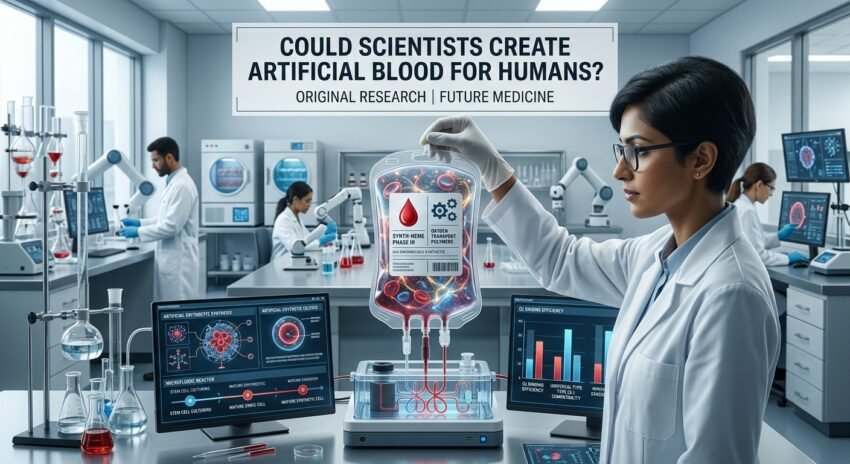
Could scientists create artificial blood that could be stored, transported, and given to patients when donated blood is unavailable?
The answer is complicated.
Scientists have already developed experimental substances that can perform some of the most important functions of blood, particularly carrying oxygen. However, creating a complete artificial replacement for human blood is far more difficult.
Blood is not simply a red liquid.
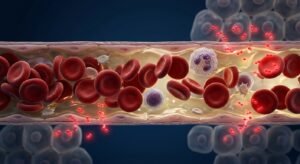
It is a highly sophisticated living system containing red blood cells, white blood cells, platelets, proteins, hormones, electrolytes, nutrients, and many other components.
Creating something that performs all of these functions safely would be an extraordinary achievement.
What Does Blood Actually Do?
To understand why artificial blood is difficult to create, it helps to understand what real blood does.
Blood has several major components.
Red Blood Cells
Red blood cells are responsible for most oxygen transport.
They contain a protein called hemoglobin, which binds oxygen in the lungs and releases it in tissues throughout the body.
This function is essential because human cells need oxygen to produce energy efficiently.
White Blood Cells
White blood cells are part of the immune system.
They help identify and respond to bacteria, viruses, parasites, damaged cells, and other threats.
Platelets
Platelets help the blood clot.
When a blood vessel is damaged, platelets participate in forming a clot that limits bleeding.
Plasma
Plasma is the liquid portion of blood.
It contains water, electrolytes, proteins, nutrients, hormones, waste products, and many other substances.
Together, these components allow blood to perform an enormous number of jobs.
That is why replacing blood completely is so difficult.
Scientists would need to reproduce many different functions simultaneously.
What Would “Artificial Blood” Actually Mean?
The term artificial blood can be misleading.
Scientists are not necessarily trying to manufacture a perfect synthetic copy of every component of human blood.
Instead, researchers have explored substances designed to perform specific functions.
One of the most important goals is oxygen transport.
If a substitute can safely carry oxygen from the lungs to tissues and help remove carbon dioxide, it could potentially be useful in situations where donated red blood cells are unavailable.
This is why much of the research into artificial blood has focused on creating oxygen-carrying blood substitutes.
Why Oxygen Is So Important
The brain, heart, and other organs require a continuous supply of oxygen.
If blood circulation stops or oxygen delivery falls dramatically, cells can begin to suffer damage within minutes.
This is why severe blood loss is so dangerous.
A patient may have enough lungs to breathe and a functioning heart, but if there is not enough circulating blood or hemoglobin to transport oxygen, tissues can still become starved of oxygen.
An artificial oxygen carrier could potentially help temporarily restore oxygen delivery.
That would make it particularly interesting for emergency medicine.
One Approach: Hemoglobin-Based Oxygen Carriers
One of the earliest ideas was to use hemoglobin itself.
Since hemoglobin is responsible for carrying oxygen in red blood cells, it seems logical to ask:
Why not take hemoglobin out of red blood cells and use it directly?
Scientists have investigated this approach for decades.
The problem is that hemoglobin normally operates inside red blood cells.
Outside the cell, its behavior is different.
Free hemoglobin can interact with blood vessels and other tissues in ways that may cause harmful effects.
Researchers therefore developed modified forms of hemoglobin designed to remain stable and function more safely outside red blood cells.
These substances are known as hemoglobin-based oxygen carriers, or HBOCs.
Some have reached clinical testing, but developing a safe and effective product has proved extremely challenging.
Potential problems have included effects on blood pressure, oxidative damage, and other complications.
As a result, scientists have not yet produced a universally accepted artificial replacement for donated red blood cells.
Another Approach: Perfluorocarbon Oxygen Carriers
Scientists have also investigated completely different chemicals called perfluorocarbons.
These compounds can dissolve substantial amounts of gases, including oxygen.
The basic idea is fascinating.
Instead of using hemoglobin to bind oxygen, a liquid containing perfluorocarbon compounds could potentially carry dissolved oxygen through the bloodstream.
However, getting such substances to work safely inside the human body is difficult.
The particles or droplets need to behave appropriately in the bloodstream, reach tissues, and eventually be removed from the body.
Researchers have investigated various formulations and delivery systems, but significant technical and biological challenges remain.
Why Can’t We Just Manufacture Red Blood Cells?
At first glance, another solution seems obvious:
Instead of creating an artificial substitute, why not simply manufacture real human red blood cells?
This idea is being investigated.
Scientists can produce blood cells from stem cells in laboratory environments.
In principle, a renewable source of red blood cells could reduce dependence on traditional blood donation.
Laboratory-grown red blood cells could also potentially offer unusual advantages.
For example, scientists might be able to produce cells with specific blood-group characteristics.
However, manufacturing enormous quantities of mature red blood cells remains difficult and expensive.
A human body contains an enormous number of red blood cells, and hospitals need blood products at a scale far beyond what many laboratory systems can currently produce economically.
Researchers therefore continue to work on improving the efficiency and scalability of cell-based blood production.
Could Stem Cells Eventually Solve the Blood Problem?
Stem-cell technology may become increasingly important.
Stem cells can develop into different types of specialized cells under appropriate conditions.
Scientists have learned how to guide stem cells toward blood-cell lineages in laboratory settings.
This raises the possibility of creating blood cells without relying entirely on human donors.
A future blood-production facility might begin with a renewable cell source and use carefully controlled biological processes to produce red blood cells.
Such technology could potentially provide rare blood types or specialized blood products.
It could also provide a more consistent supply for certain patients.
But several challenges remain, including production scale, cost, quality control, storage, and ensuring that laboratory-produced cells behave properly inside the human body.
What About Artificial Platelets?
Oxygen transport is only one part of the problem.
Patients who experience major bleeding also need their blood to clot.
Platelets are central to this process.
Scientists have therefore explored synthetic or engineered particles that could help support clot formation.
Some experimental approaches involve particles designed to accumulate near wounds and assist the body’s natural clotting mechanisms.
The goal is not necessarily to create a perfect artificial platelet.
Instead, researchers may be able to create a material that performs enough of a platelet’s function to reduce bleeding.
Such technology could be particularly valuable in emergency medicine.
Imagine a trauma patient arriving at a hospital after losing a large amount of blood.
If a shelf-stable product could rapidly support oxygen delivery or clotting while conventional blood products were being prepared, it could potentially provide doctors with additional time.
Could Artificial Blood Be Stored for Years?
One of the biggest attractions of artificial blood is storage.
Donated blood products have specific storage requirements and limited shelf lives.
Artificial or engineered oxygen carriers could potentially be designed to remain stable for much longer.
This could be particularly useful for emergency services, military medicine, disaster response, ambulances, remote clinics, and locations where blood banks are difficult to maintain.
A future emergency kit might contain a stable blood substitute that can be stored until needed.
However, this is a goal rather than a universal reality.
Any product used inside the human bloodstream must remain chemically stable and safe throughout its storage period.
It must also work predictably once administered.
Could Artificial Blood Work for Every Blood Type?
One of the most attractive possibilities is a blood substitute that does not require traditional blood-type matching.
Human blood groups differ because red blood cells carry different molecules on their surfaces.
Giving incompatible blood can trigger a dangerous immune reaction.
This means hospitals carefully determine a patient’s blood type and match compatible blood products whenever possible.
A sufficiently advanced artificial oxygen carrier that lacks the relevant blood-group markers could potentially reduce some compatibility problems.
This could be especially valuable in emergencies when a patient’s blood type is not immediately known.
But “universal blood” does not automatically mean “risk-free blood.”
The immune system can respond to many foreign substances, and researchers would still need to establish safety through extensive testing.
Could Artificial Blood Help in Remote Areas?
Another potential advantage is transportation.
Real blood requires a carefully managed supply chain.
Hospitals need collection centers, testing facilities, refrigeration, transportation, inventory management, and trained personnel.
Remote locations can have difficulty maintaining these systems.
A stable artificial blood product could potentially be transported more easily.
This could be useful during natural disasters, humanitarian emergencies, remote medical missions, and other situations where conventional blood supplies are difficult to access.
For example, after a major earthquake, hospitals could face large numbers of trauma patients while roads and transportation networks are damaged.
Having stable emergency blood substitutes available could potentially provide an additional layer of preparedness.
Could Artificial Blood Save Lives in Accidents?
Trauma medicine is one of the areas where artificial oxygen carriers could have significant potential.
Severe bleeding can happen rapidly.
Paramedics may have only a limited amount of time to stabilize a patient before reaching a hospital.
In such circumstances, restoring circulation and oxygen delivery is critical.
A future oxygen-carrying substitute could potentially be administered during emergency transport if proven safe and effective.
However, replacing lost blood is not simply a matter of replacing oxygen.
Doctors must also restore blood volume, control bleeding, maintain clotting, manage body temperature, and address the underlying injuries.
Artificial blood would therefore be one tool within a much larger emergency-care system.
Why Has Artificial Blood Been So Difficult to Develop?
The central problem is that blood is incredibly complicated.
A synthetic substance might carry oxygen but fail to reproduce other functions of red blood cells.
Another material might help clotting but create unwanted inflammation.
A laboratory-grown red blood cell might behave similarly to a natural cell but be expensive to manufacture at large scale.
The human bloodstream is also an extremely demanding environment.
Anything injected into it interacts with blood vessels, immune cells, proteins, organs, and countless biochemical systems.
Small changes can have large consequences.
This is why a substance that works well in a laboratory experiment may fail during animal testing or human clinical trials.
The Problem of Safety
Safety is one of the biggest barriers.
Blood substitutes circulate throughout the entire body.
That means researchers must carefully study their effects on organs such as the heart, kidneys, liver, lungs, and brain.
They must also determine how long the substance remains in the body and how it is eventually removed.
Potential side effects must be understood before widespread medical use.
This process can take years.
It is not enough for scientists to show that a product carries oxygen.
They must demonstrate that it provides meaningful medical benefits without creating unacceptable risks
. 
Could Artificial Blood Be Created Using Nanotechnology?
Nanotechnology could eventually provide another route.
Scientists can engineer extremely small particles with carefully controlled properties.
In theory, nanoparticles could be designed to transport oxygen, deliver therapeutic molecules, assist clotting, or interact with damaged tissues.
Researchers are investigating many types of medical nanoparticles, although creating a safe artificial blood system would be much more complicated than designing a simple drug-delivery particle.
A future blood substitute might potentially contain multiple engineered components, each performing a different function.
One component could transport oxygen.
Another could help control bleeding.
Another might help maintain blood volume.
Such a system would resemble a collection of specialized biological tools rather than a simple replacement for natural blood.
Could AI Help Create Artificial Blood?
Artificial intelligence could also accelerate research.
Developing blood substitutes requires understanding chemistry, biology, materials science, medicine, and fluid dynamics.
AI systems can analyze large datasets and help researchers identify relationships between molecular structures and biological effects.
Scientists could use computational models to screen potential oxygen-carrying molecules or predict how materials might interact with biological systems.
AI could also help optimize manufacturing processes and analyze clinical data.
But AI-generated predictions still require laboratory and clinical validation.
A computer model cannot replace safety testing.
Will Artificial Blood Completely Replace Donated Blood?
That is difficult to predict.
Even if scientists develop excellent artificial oxygen carriers, natural blood contains many functions that would be difficult to reproduce.
For example, plasma contains a complex mixture of proteins and signaling molecules.
White blood cells provide immune functions.
Platelets participate in a sophisticated biological response to injury.
Red blood cells have specialized physical properties that allow them to move through extremely small blood vessels.
Because of this complexity, the future may involve partial replacements rather than one artificial liquid that performs every function of blood.
Doctors might use different engineered products for different situations.
For example, one product could support oxygen delivery, another could assist clotting, and laboratory-grown blood cells could provide a renewable source of red blood cells.
What Could Blood Transfusions Look Like in the Future?
Imagine an emergency room several decades from now.
A patient arrives after severe trauma.
Instead of depending entirely on whether a compatible unit of donated blood is immediately available, doctors may have access to several types of engineered blood products.
An oxygen-carrying substitute could help stabilize the patient.
Engineered clotting particles could assist with bleeding control.
Laboratory-grown red blood cells could provide longer-term oxygen transport.
Conventional donated blood could still be used when appropriate.
In this future, artificial blood would not necessarily eliminate blood donation.
It could instead provide additional options.
That could make the overall medical system more resilient.
Could Scientists Eventually Create a Complete Artificial Blood?
A complete artificial replacement for human blood would be one of the most impressive achievements in medical engineering.
Such a system would need to perform many functions simultaneously.
It would need to:
- Transport oxygen
- Help transport carbon dioxide
- Maintain appropriate blood volume
- Support clotting
- Interact safely with blood vessels
- Avoid dangerous immune reactions
- Carry or regulate important molecules
- Remain stable during storage
- Be safely removed or metabolized
- Work reliably across different patients
Achieving all of these functions with a manufactured product would be extraordinarily difficult.
But science has repeatedly shown that biological functions can sometimes be reproduced piece by piece.
The first successful artificial blood product may therefore not look like natural blood at all.
It might be a collection of specialized technologies working together.

The Future of Artificial Blood
Scientists have not yet created a perfect artificial replacement for human blood.
But the research is moving in several directions.
Researchers are exploring oxygen-carrying molecules, engineered particles, laboratory-grown blood cells, stem-cell technology, artificial platelets, nanotechnology, and advanced manufacturing.
Each approach addresses a different part of the problem.
The most realistic future may not involve one magical substitute that completely replaces human blood.
Instead, medicine could develop a toolbox of artificial and laboratory-grown products that perform specific blood functions.
This could reduce dependence on donated blood in some situations, improve emergency medicine, and provide new options for patients with rare blood types or difficult transfusion requirements.
The Bottom Line
So, could scientists create artificial blood for humans?
The answer is yes, in limited and specialized forms, scientists are already working toward this goal—but a complete replacement for natural human blood remains an unsolved challenge.
The key breakthrough may come from combining several fields: stem-cell biology, materials science, nanotechnology, synthetic biology, medicine, and artificial intelligence.
If researchers can solve the problems of safety, effectiveness, scalability, and cost, artificial blood could eventually become an important part of modern healthcare.
It could sit on hospital shelves, travel to remote medical centers, accompany emergency teams, and potentially provide lifesaving support when donated blood is unavailable.
For now, human donors remain essential.
But the idea of manufacturing some of the most important functions of blood is no longer purely science fiction.
The future may bring a medical world where blood does not always have to come from another person.
Instead, some of it could one day come from a laboratory.