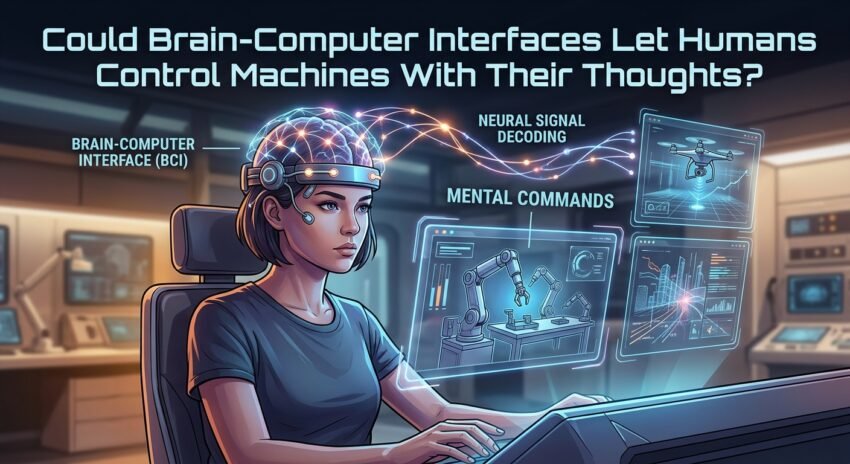
Could Brain-Computer Interfaces Let Humans Control Machines With Their Thoughts?
Imagine moving a robotic arm without physically touching it. You think about reaching for an object, and the machine responds. Imagine typing words on a computer without pressing a keyboard, controlling a wheelchair without using your hands, or interacting with a digital device simply by producing a specific pattern of brain activity.
This sounds like science fiction, but researchers are already developing technologies that can translate certain patterns of brain activity into commands for computers and machines.
These technologies are called brain-computer interfaces, or BCIs.
A BCI creates a communication pathway between the brain and an external device. Instead of relying entirely on muscles, nerves, keyboards, or touchscreens, a BCI attempts to interpret signals produced by the brain and convert them into useful commands.
But how close are we to controlling machines with our thoughts?
The answer is more complicated than movies and science-fiction stories suggest.
Scientists have demonstrated impressive experiments involving computer cursors, robotic limbs, speech-related systems, and other devices. However, today’s BCIs are still experimental, limited, and far from allowing people to control any machine simply by thinking about it.
Understanding how this technology works helps explain both its enormous potential and its challenges.
What Is a Brain-Computer Interface?
A brain-computer interface is a system that detects brain activity and translates it into information that a computer can use.
Normally, the brain controls the body through the nervous system.
For example, when you decide to move your hand, networks of neurons in your brain become active. Signals travel through the nervous system to muscles, producing movement.
A BCI attempts to access information from brain activity directly.
Instead of waiting for the brain’s commands to travel through the normal movement pathway, researchers measure electrical or other signals associated with brain activity and use algorithms to interpret them.
The computer can then transform the interpreted signal into an action.
The process can be simplified into three stages:
Brain activity → signal recording → computer interpretation → machine action
The difficult part is making the middle of this process reliable.
The human brain contains billions of neurons, producing incredibly complex patterns of electrical activity. Scientists cannot simply read every thought like words on a computer screen.
Instead, BCIs generally focus on specific, measurable patterns associated with particular intentions or tasks.
Can a Computer Really Read Your Thoughts?
Not in the science-fiction sense.
A BCI does not currently provide a machine with unrestricted access to a person’s private thoughts.
Researchers typically train systems to recognize particular patterns of brain activity.
For example, a person might repeatedly imagine moving a hand in a particular direction. A machine-learning system can learn that a certain pattern of brain activity corresponds to that intended action.
The system can then use similar patterns to control a cursor or another device.
This is very different from reading someone’s memories, dreams, secrets, or every thought.
Modern BCIs are better described as decoding specific brain signals or intentions rather than reading the entire mind.
How Does the Brain Produce Signals?
Neurons communicate using electrical and chemical processes.
When groups of neurons become active, their activity creates electrical signals that can sometimes be detected outside individual neurons.
BCI researchers attempt to measure these signals using different technologies.
Some systems use electrodes placed directly on or inside the brain.
Other systems use sensors positioned outside the skull.
The closer the sensors are to the relevant neurons, the more detailed the signals can potentially be. But invasive systems also involve greater medical risks.
This creates one of the central trade-offs in BCI development:
Better access to brain signals can come with greater invasiveness.
Invasive Brain-Computer Interfaces
Invasive BCIs involve placing electrodes inside the skull or directly on brain tissue.
Because the electrodes are close to neurons, they can record relatively detailed neural activity.
This approach has been used in research involving people with severe neurological disabilities.
In some experiments, participants have learned to control computer cursors or robotic devices using neural signals.
For people who cannot move or speak normally, this technology could eventually provide new ways to communicate and interact with their surroundings.
However, implanting devices into the brain is a medical procedure.
There are risks associated with surgery, infection, inflammation, and long-term device performance.
Researchers therefore have to balance potential benefits against medical risks.
Non-Invasive Brain-Computer Interfaces
Scientists are also developing BCIs that do not require brain surgery.
One of the most widely studied approaches uses electroencephalography, or EEG.
An EEG system uses sensors placed on the scalp to detect electrical activity associated with the brain.
The major advantage is that EEG does not require electrodes to be implanted inside the brain.
However, the skull and other tissues weaken and blur the signals before they reach the sensors.
This makes it more difficult to identify highly detailed neural activity.
Other non-invasive technologies are also being researched, including methods that use magnetic or optical measurements of brain activity.
Each technology has advantages and limitations.
How Could Someone Control a Robotic Arm?
Consider a person who cannot move their arms.
A BCI could potentially record brain activity associated with the intention to move.
The system could then analyze those signals using software.
If the algorithm determines that the person intends to move a robotic arm upward, it could send a command to the robotic system.
The robotic arm could then perform the movement.
In more advanced systems, the user might control several aspects of movement, such as direction, speed, or grasping.
This could potentially allow a person to interact with objects that they cannot physically reach.
The technology is still being developed, but research has demonstrated that neural signals can be used to control external devices.
BCIs Could Transform Communication
One of the most important applications of BCIs may not be controlling robots.
It could be communication.
People with severe paralysis or conditions that prevent normal speech may have difficulty communicating.
If a BCI can detect signals associated with intended speech or communication, a computer could potentially convert those signals into text or synthesized speech.
Researchers are investigating systems designed to decode speech-related neural activity.
The goal is not necessarily to make someone communicate faster than a normal speaker.
For some users, simply providing a reliable communication pathway could be life-changing.
A person who cannot physically speak might eventually be able to express sentences through a computer interface.
Could BCIs Restore Movement?
Another major goal is restoring movement.
A person with paralysis may still have brain activity associated with the intention to move even though signals cannot successfully reach the muscles.
A BCI could potentially create an alternative pathway.
For example:
Brain → BCI → computer → robotic device
In future systems, the pathway might be even more sophisticated:
Brain → BCI → stimulation system → muscles
Such technologies could potentially combine brain signals with functional electrical stimulation or other approaches to help restore movement.
Researchers are investigating different strategies, but reliable long-term restoration of natural movement remains a major scientific and engineering challenge.
Could Humans Control Computers Without a Keyboard?
Potentially, yes.
A BCI could allow users to interact with a computer using neural signals.
Instead of moving a mouse physically, a user might generate a trained brain signal corresponding to cursor movement.
Similarly, specific neural patterns could potentially select letters, commands, or interface elements.
However, this does not mean keyboards and touchscreens will disappear soon.
A conventional keyboard is extremely efficient, inexpensive, and reliable.
For healthy users, using a BCI may not necessarily provide an immediate advantage.
The strongest early applications are therefore likely to involve people who cannot easily use conventional input devices.
Could BCIs Enhance Human Abilities?
This is where the subject becomes more speculative.
Scientists and engineers have discussed whether future BCIs could allow healthy people to interact with technology in completely new ways.
Imagine controlling a computer interface without moving your hands.
Or controlling a robotic system from a distance using neural signals.
Or interacting with augmented-reality systems through brain activity.
These possibilities are being explored conceptually and experimentally, but many remain far from practical everyday technology.
The challenge is not merely detecting brain signals.
The system must interpret them accurately, quickly, safely, and consistently.
The Brain Is Extremely Complicated
One of the biggest challenges is the complexity of the human brain.
There is no simple “thought center” where every intention is stored.
Different brain regions and networks participate in movement, perception, language, memory, emotion, decision-making, and many other processes.
Even apparently simple actions can involve large networks of neurons.
Two attempts to perform the same task may also produce somewhat different neural activity.
This means BCI systems often need to be trained for individual users.
A system that works well for one person may not automatically work equally well for another.
Researchers are working on algorithms that can adapt to these differences.
Signal Quality Is a Major Challenge
Neural signals can be weak and noisy.
In non-invasive systems, signals have to pass through the skull before reaching sensors.
In implanted systems, electrodes can record more detailed information, but the body can respond to implanted materials over time.
Electrode performance can also change.
A BCI that works well during one experiment might require recalibration later.
For a technology intended to operate every day, researchers need systems that remain stable over long periods.
Artificial Intelligence Is Important to BCIs
Modern BCIs increasingly depend on machine learning.
The brain produces complicated signals that are difficult to interpret using simple rules.
Machine-learning algorithms can identify patterns within large datasets.
During training, the system can learn relationships between neural signals and known actions or intentions.
For example, the system might observe brain activity while a person attempts different cursor movements.
Over time, the algorithm can learn which patterns correspond to which commands.
Advanced AI models could potentially make BCIs more adaptable and capable.
But AI also introduces questions about reliability, transparency, privacy, and safety.
Could Someone Hack a Brain-Computer Interface?
As BCIs become more sophisticated, cybersecurity could become increasingly important.
A conventional computer contains information that can potentially be stolen or manipulated.
A BCI could eventually process highly sensitive biological information.
Researchers and policymakers therefore have reason to consider how neural data should be protected.
Questions may include:
Who owns neural data?
Who can access it?
Can users permanently delete it?
How should companies store it?
Could malicious software interfere with a BCI?
These issues are especially important because neural information is closely connected to an individual’s privacy.
The Ethical Questions Are Just Beginning
BCIs raise ethical questions that do not have simple answers.
If a machine helps a person communicate, who should control the data?
If a BCI becomes capable of influencing movement, how should responsibility be handled if something goes wrong?
Could employers ever pressure workers to use neural interfaces?
Could future technologies create differences between people who can afford advanced neural devices and those who cannot?
These questions are part of the broader discussion surrounding emerging technologies.
The science may advance faster than society’s ability to establish rules for its use.
Could BCIs Connect Humans Directly to Machines?
This is one of the most exciting long-term possibilities.
Today, humans interact with machines primarily through physical interfaces.
We press buttons, move joysticks, type on keyboards, speak commands, or touch screens.
A sufficiently advanced BCI could provide a more direct communication pathway.
The human brain would generate an intention, the BCI would decode relevant neural activity, and a machine would respond.
This could make interaction with some machines faster and more natural.
However, “direct” does not mean perfect.
There would still be a decoding process between brain activity and machine behavior.
The technology would need to understand the user’s intentions correctly.
Could BCIs Become Common in the Future?
It is possible, but nobody can say exactly when.
Medical applications are likely to remain an important area because the potential benefits can be substantial for people with severe disabilities.
Non-invasive BCIs may also find specialized uses if researchers can make them sufficiently accurate and convenient.
More advanced implanted BCIs could eventually provide capabilities that are currently difficult to imagine.
But widespread adoption would depend on more than scientific breakthroughs.
Devices would need to be safe, affordable, reliable, comfortable, secure, and supported by appropriate medical and regulatory systems.
The Future of Human-Machine Interaction
Brain-computer interfaces represent a remarkable change in how scientists think about communication between humans and machines.
The technology does not currently allow computers to read every human thought.
Instead, researchers are learning how to identify specific patterns of brain activity associated with movement, communication, and other intentions.
Experiments have already demonstrated that neural signals can be translated into commands for computers and external devices.
Future systems could potentially help people communicate, control robotic limbs, interact with computers, and restore some lost functions.
Further into the future, BCIs could potentially become part of entirely new forms of human-machine interaction.
But significant challenges remain.
Scientists still need to improve signal quality, decoding accuracy, long-term stability, safety, usability, and privacy.
The brain is one of the most complicated systems known to science, and connecting it reliably to a machine is an enormous challenge.
Still, the basic idea is no longer science fiction.
Humans have already demonstrated that brain activity can be translated into machine commands.
The bigger question is how far this technology can eventually go.
One day, interacting with a machine might require less physical movement and more direct communication between the brain and the digital world.
If that happens, brain-computer interfaces could become one of the most significant technologies in the history of human-machine interaction.