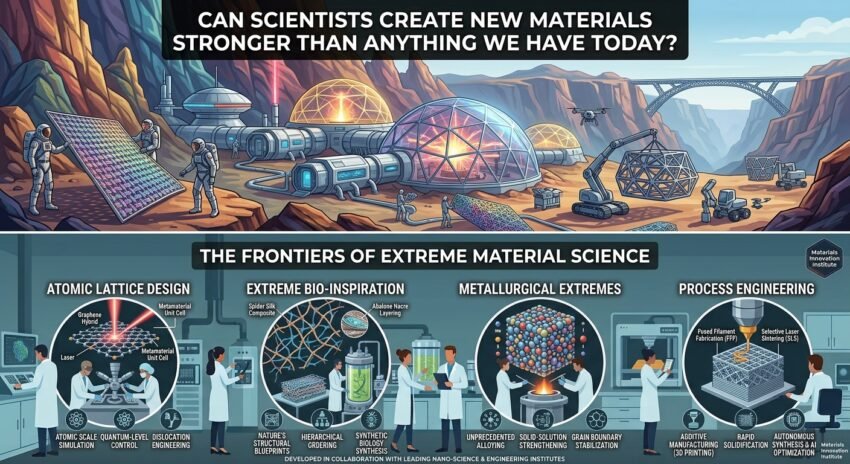
Can Scientists Create New Materials Stronger Than Anything We Have Today?
Imagine a material that is lighter than aluminum but stronger than steel. It could withstand enormous forces, extreme temperatures, radiation, or intense pressure without breaking. Aircraft could become lighter, spacecraft could become more efficient, buildings could use less material, and machines could operate in environments that are currently too dangerous.
This sounds like science fiction, but scientists are already developing materials with remarkable combinations of strength, lightness, flexibility, heat resistance, and durability.
The important question is not simply whether scientists can make something “stronger than steel.”
They can.
The bigger question is:
Can scientists create materials that are dramatically stronger, lighter, and more versatile than the materials we use today?
The answer is potentially yes, but there are major scientific and engineering challenges.Materials science is increasingly allowing researchers to design materials at the level of atoms and molecules. Instead of simply discovering materials in nature, scientists can manipulate their structures and combine different substances to produce properties that conventional materials cannot easily achieve.
What Does “Strong” Actually Mean?
Before discussing futuristic materials, it is important to understand what scientists mean by strength.
Strength is not one single property.A material can be strong in one way but weak in another.
For example, tensile strength describes how much pulling force a material can withstand before breaking.
Compressive strength describes how well a material withstands forces pushing it together.
Hardness refers to resistance against scratching, indentation, or deformation.
Toughness describes how much energy a material can absorb before fracturing.
Stiffness describes how much a material resists deformation.
A material might therefore be extremely hard but relatively brittle, while another material may be flexible and tough but not especially hard.
This is why developing a truly revolutionary material is difficult.
Scientists are often trying to improve several properties at the same time.
Nature Already Makes Remarkably Strong Materials
Some of the best inspiration for advanced materials comes from nature.
Spider silk is a famous example.Certain types of spider silk combine impressive strength with flexibility and toughness. The microscopic structure of the silk proteins helps produce these unusual properties.
Another example is the structure of bone.
Bone is not simply a solid block of one material. It is a complex composite made primarily from mineral and organic components arranged in a sophisticated architecture.
The structure allows bone to be strong while remaining relatively lightweight.
Scientists study such natural materials because nature has had enormous amounts of time to develop efficient structures.
The goal is not necessarily to copy nature exactly.
Instead, researchers can learn from biological structures and apply similar principles to engineered materials.
Graphene: A Two-Dimensional Material
One of the most famous advanced materials is graphene.
Graphene consists of a single layer of carbon atoms arranged in a hexagonal pattern.
Although it is extremely thin, graphene has remarkable mechanical, electrical, and thermal properties.
Its structure gives it exceptional intrinsic strength.
It is also highly conductive and can be extremely flexible.
These characteristics have made graphene one of the most studied advanced materials in modern science.
However, there is an important distinction between the properties of an individual graphene sheet and the performance of a large manufactured object.
Producing large quantities of high-quality graphene with consistent properties can be challenging.
Researchers are therefore investigating ways to incorporate graphene into composites and other engineered structures.
The future may not involve building entire objects from pure graphene.
Instead, graphene could become one component of advanced materials designed to combine multiple useful properties.
Carbon Nanotubes Could Push Strength Even Further
Carbon nanotubes are another remarkable class of carbon-based materials.
A carbon nanotube can be imagined as a sheet of graphene rolled into a tiny cylindrical structure.
At the nanoscale, carbon nanotubes can have exceptional strength and stiffness relative to their weight.
They also have unusual electrical and thermal properties.
Scientists have investigated carbon nanotubes for applications ranging from electronics to aerospace materials.
One challenge is turning the extraordinary properties of individual nanotubes into the properties of a large, practical object.
When billions or trillions of tiny structures are assembled together, defects, alignment, connections, and manufacturing processes can affect the final performance.
This is one of the central challenges of nanotechnology:
A material can be extraordinary at the nanoscale but much more ordinary when produced at industrial scale.
The Power of Nanotechnology
Nanotechnology involves manipulating matter at extremely small scales.
At these dimensions, materials can behave differently from their larger-scale versions.
Scientists can potentially control how atoms and molecules are arranged to produce specific properties.
This opens the possibility of designing materials rather than simply selecting them.
Imagine being able to specify a material that needs to be lightweight, extremely strong, resistant to corrosion, capable of conducting electricity, and stable at high temperatures.
Researchers can then investigate structures that might produce those characteristics.
Computer simulations can help predict how atoms will behave before scientists attempt to manufacture the material.
This combination of computation, chemistry, physics, and engineering is changing how new materials are discovered.
Metamaterials: Designing the Structure
Some futuristic materials are unusual not because of their chemical composition, but because of how their internal structures are designed.
These are often called metamaterials.
A metamaterial can contain carefully engineered structures that produce properties not normally found in conventional materials.
Researchers have investigated metamaterials for applications involving light, sound, electromagnetic waves, vibration, and mechanical behavior.
For example, specially structured materials can be designed to manipulate waves in unusual ways.
This means the future of materials science may increasingly depend on architecture.
Scientists may not simply ask:
“What substance should we use?”
They may ask:
“How should we arrange the substance?”
Strong Materials That Are Also Lightweight
For transportation, strength alone is not enough.
Weight matters enormously.
Every kilogram saved from an aircraft, spacecraft, car, or satellite can affect energy consumption and performance.
This is why engineers use materials such as carbon-fiber composites.
Carbon-fiber-reinforced polymers can provide high strength and stiffness at relatively low weight.
Advanced composites could become even more important as scientists develop better manufacturing methods.
Future aircraft may use increasingly sophisticated combinations of fibers, polymers, metals, ceramics, and nanoscale materials.
The objective would be to achieve the right combination of properties rather than simply maximizing one measurement.
Materials That Can Repair Themselves
One of the most fascinating directions in materials science is self-healing materials.
Biological systems already demonstrate this principle.
Humans can repair damaged skin and bones through biological processes.
Scientists are investigating whether engineered materials can similarly repair cracks or other damage.
Some experimental self-healing materials contain chemicals that can react when a crack forms.
Other approaches use polymers, microcapsules, vascular-like networks, or reversible chemical bonds.
Self-healing materials could potentially extend the lifespan of structures and reduce maintenance.
Imagine an aircraft component, bridge material, or spacecraft structure that could automatically repair certain types of microscopic damage before the damage becomes a major failure.
Such technology would not make materials indestructible, but it could make them more resilient.
Materials That Can Survive Extreme Heat
Future spacecraft, aircraft, power systems, and industrial machines will require materials capable of operating under extreme temperatures.
Traditional metals have limits.
At sufficiently high temperatures, materials can weaken, deform, melt, or react with their surroundings.
Ceramics can withstand much higher temperatures than many metals, making them valuable for extreme environments.
Scientists are also investigating advanced high-temperature materials, including ceramic-matrix composites and specialized alloys.
These materials could have applications in jet engines, spacecraft, energy systems, and industrial manufacturing.
The challenge is balancing heat resistance with toughness and manufacturability.
A material that survives extremely high temperatures but shatters easily may not be useful for many applications.
Could Materials Become Nearly Unbreakable?
It is tempting to imagine a material that cannot break.
In reality, every material has limits.
Even extremely strong materials can fail under sufficient stress, temperature, radiation, chemical attack, or repeated loading.
Scientists therefore focus on improving damage tolerance and understanding how cracks begin and spread.
At microscopic scales, tiny defects can become starting points for failure.
Controlling defects is therefore critical.
Future materials could potentially contain carefully engineered structures that stop cracks from spreading.
Instead of preventing every crack, the material could be designed to make cracks lose energy as they travel.
This could produce materials that are much tougher than their individual components might suggest.
Could Scientists Design Materials Atom by Atom?
In principle, scientists can manipulate atoms and molecules with extraordinary precision in laboratories.
But manufacturing a useful object atom by atom is not currently practical on an everyday industrial scale.
Instead, researchers use chemistry, materials processing, nanotechnology, additive manufacturing, and computational modeling to control structures at different scales.
The ultimate goal is often hierarchical design.
A material could be engineered from atoms to molecules, molecules to nanoscale structures, nanoscale structures to microscopic structures, and microscopic structures to a finished component.
This is similar to how nature builds complex structures.
The challenge is maintaining control across all these scales.
Artificial Intelligence Could Accelerate Materials Discovery
Artificial intelligence and machine learning are becoming increasingly useful in materials science.
The number of possible combinations of elements, compounds, structures, and manufacturing conditions is enormous.
Testing every possibility experimentally would be impossible.
Computational methods can narrow the search.
AI systems can analyze existing scientific data and identify patterns that might help researchers predict promising materials.
Scientists can then synthesize the most promising candidates and test them in laboratories.
This creates a cycle:
Prediction → experiment → data → improved prediction → new experiment.
As computational power and scientific databases improve, this approach could significantly accelerate materials discovery.
AI does not eliminate the need for experiments, but it can help researchers decide which possibilities are worth testing.
Could Future Materials Help Space Exploration?
Advanced materials could have an enormous impact on space exploration.
Spacecraft need to be strong but lightweight.
They must survive vibration during launch, extreme temperature changes, radiation, vacuum, and potentially high-speed impacts from tiny particles.
Future materials could reduce spacecraft mass while increasing durability.
For Mars missions, materials would also need to withstand dust and large temperature variations.
For more ambitious missions, such as sending probes toward other stars, extremely lightweight structures could become particularly important.
Even a small reduction in mass can have a major effect on propulsion requirements.
Stronger Buildings With Less Material
Advanced materials could also transform construction.
Concrete and steel are among the most important construction materials in the world, but future buildings could increasingly use engineered composites, advanced concrete, lightweight structures, and materials with improved durability.
A material that can withstand greater loads while requiring less mass could make some structures more efficient.
Self-healing materials could potentially reduce maintenance.
Materials resistant to corrosion could extend the life of bridges and infrastructure.
Advanced insulation materials could improve energy efficiency.
The future of construction may therefore depend not only on making materials stronger, but on making them smarter and more durable.
Why Don’t We Already Have These Materials Everywhere?
If scientists can create remarkable materials in laboratories, why aren’t they already used in everything?
The answer is manufacturing.
A material can look extraordinary in a laboratory sample but become difficult to produce economically at large scale.
Researchers must consider:
- Cost
- Availability of raw materials
- Manufacturing speed
- Quality control
- Safety
- Environmental impact
- Recycling
- Long-term stability
- Compatibility with existing manufacturing systems
A material that is twice as strong but ten thousand times more expensive may have very limited practical use.
This is why engineering is often more difficult than discovering a promising material.
The Future May Be About Combinations
The strongest material of the future may not be one mysterious substance.
It could be a carefully engineered combination of several materials.
For example, a future composite might combine high-strength fibers, a lightweight matrix, nanoscale reinforcement, and a structure designed to stop cracks.
Different layers could perform different functions.
One layer might provide mechanical strength.
Another could provide thermal protection.
Another could conduct electricity.
Another could repair small amounts of damage.
This concept is already visible in modern composite materials, but future manufacturing techniques could make such multifunctional structures much more sophisticated.
Could There Be a Material Stronger Than Anything We Know Today?
Almost certainly, scientists will continue to discover and engineer materials with properties that outperform existing materials in particular ways.
But “stronger than anything we have today” needs context.
A material may have greater tensile strength but lower toughness.
Another may be extremely lightweight but difficult to manufacture.
Another may survive incredible temperatures but be brittle.
There may never be one material that is the best at everything.
Instead, the future could bring a wide range of specialized materials designed for specific environments.
Some could be optimized for spacecraft.
Others could be designed for medical implants, electronics, energy systems, construction, transportation, or extreme industrial environments.
A New Era of Designed Matter
For most of human history, people worked with materials that nature provided.
Stone, wood, copper, iron, and other natural materials were gradually processed into useful tools.
Modern science has changed the relationship between humans and matter.
We can now manipulate atoms, molecules, crystal structures, polymers, composites, and nanoscale architectures.
Scientists can use computer simulations to predict materials before manufacturing them.
They can study materials using advanced microscopes and instruments that reveal structures at extraordinarily small scales.
And increasingly, artificial intelligence can help search enormous numbers of possible material designs.
This suggests that the future of materials science may be less about discovering what nature happens to provide and more about designing materials for specific purposes.
The Materials of Tomorrow
So, can scientists create new materials stronger than anything we have today?
Yes, in specific properties and applications, this is already happening.
Researchers have developed and studied materials with extraordinary strength, stiffness, toughness, heat resistance, conductivity, and other properties.
The challenge is combining these properties into materials that can be manufactured reliably, affordably, and at useful scales.
The most exciting developments may come from the combination of several fields: nanotechnology, artificial intelligence, advanced manufacturing, chemistry, physics, and engineering.
Future materials could be lighter, stronger, tougher, more heat-resistant, more adaptable, and potentially even capable of repairing certain types of damage.
We may eventually build spacecraft from materials designed specifically for deep-space travel, vehicles from ultra-light composites, buildings from highly durable structures, and electronic devices from materials engineered at the atomic scale.
The next great revolution in technology may therefore not be a new machine.
It may be the material that makes an entirely new generation of machines possible.
And as scientists learn to control matter with greater precision, the boundary between science fiction and materials engineering could become increasingly difficult to distinguish.