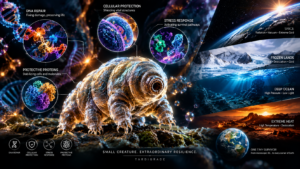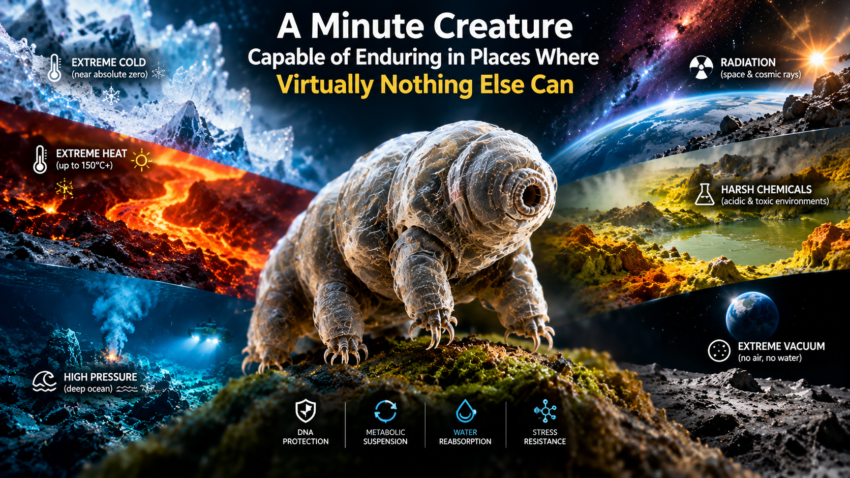
A Minute Creature Capable of Enduring in Places Where Virtually Nothing Else Can
Life on Earth exists in places that once seemed completely unsuitable for living organisms. Microorganisms can survive inside boiling environments, beneath Antarctic ice, in highly acidic waters, deep underground, and in places exposed to intense radiation. Among the most remarkable examples is a microscopic animal that has attracted enormous scientific attention because of its ability to survive conditions that would quickly destroy most forms of life.
This extraordinary organism is the tardigrade, commonly known as the water bear.
Tardigrades are microscopic animals with eight legs, typically less than a millimeter long. Even though they are tiny, they have an amazing capacity to endure environmental conditions that would kill most organisms. They are able to withstand severe dehydration, extremely cold temperatures, high pressure, and radiation exposure. In some situations, they can even endure the vacuum of space for short periods of time.
Their remarkable survival ability has made tardigrades an important subject of research in biology, genetics, astrobiology, and the study of extreme environments.
But the most interesting question is not simply how these animals survive.
It is how such a tiny organism evolved biological mechanisms capable of protecting its cells from extreme damage.
The Discovery of the Tardigrade
The scientific story of tardigrades began in the eighteenth century.
In 1773, German zoologist Johann August Ephraim Goeze described these microscopic creatures after observing them under a microscope. He reportedly called them “little water bears” because of their unusual appearance and slow, bear-like movement.
The name Tardigrada, meaning “slow step,” was later introduced by Italian biologist Lazzaro Spallanzani in the eighteenth century.
At the time, scientists had no idea that these tiny organisms possessed extraordinary survival abilities.
They were initially interesting mainly because of their unusual anatomy and movement.
It would take many years of experimentation before researchers discovered just how unusual they were.

What Makes a Tardigrade So Special?
A tardigrade is a small animal with a relatively simple body plan.
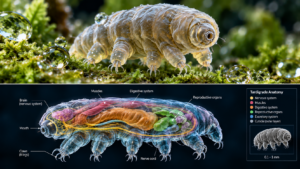
It has eight legs, a head, a digestive system, muscles, reproductive organs, and a nervous system. Some species live in freshwater or marine environments, while others are found in moist habitats such as moss, lichens, soil, and leaf litter.
Under normal conditions, tardigrades behave much like other microscopic animals.
They move around, feed, reproduce, and interact with their environment.
The extraordinary ability appears when environmental conditions become dangerous.
When the surrounding environment becomes extremely dry, some tardigrade species can enter a special state called anhydrobiosis.
Instead of continuing normal biological activity, the animal loses most of the water in its body and contracts into a compact structure called a tun.
Its metabolism can decrease to extremely low levels.
In this state, many of the normal chemical reactions required for active life are dramatically reduced.
The animal essentially enters a form of biological suspension.
When water becomes available again, the tardigrade can rehydrate and return to active life.
This process is one of the major reasons tardigrades have become so important to scientists.
The Discovery of Cryptobiosis
The phenomenon is connected to a broader biological concept known as cryptobiosis.
Cryptobiosis describes a state in which an organism’s metabolic activity becomes extremely low in response to environmental conditions.
The organism does not necessarily die.
Instead, many biological processes are slowed or suspended until conditions become favorable again.
Tardigrades are among the most famous organisms capable of entering this state.
This discovery changed how scientists thought about the boundaries of life.
For most animals, severe dehydration causes cells to lose their structure and function.
Water is essential for cellular chemistry.
Proteins require appropriate environments to maintain their shapes. Cell membranes can become damaged. DNA can be affected. Metabolic reactions stop functioning normally.
Yet tardigrades have evolved mechanisms that allow them to protect their biological structures during extreme dehydration.
How Does a Tardigrade Survive Without Water?
This is one of the most important questions in tardigrade research.
When a tardigrade loses water, it cannot simply continue functioning normally.
Instead, its cells undergo major biochemical changes.
Researchers have discovered that certain tardigrade proteins appear to help protect cellular structures during dehydration.
Some of these proteins are associated with intrinsically disordered proteins, which can behave differently from conventional proteins and may help stabilize cellular components during extreme drying.
Scientists have also investigated molecules such as trehalose, a sugar that helps some organisms tolerate dehydration.
However, tardigrades do not rely on exactly the same mechanism as every other drought-tolerant organism.
Different tardigrade species can use different combinations of protective strategies.
This makes them especially interesting for comparative biology.
Researchers want to understand which mechanisms are ancient, which evolved independently, and which are unique to particular tardigrade groups.
Surviving Extreme Cold
Tardigrades are also famous for their resistance to very low temperatures.
When their metabolism is extremely reduced, they can tolerate freezing conditions that would damage ordinary active animals.
However, it is important to understand that “surviving extreme cold” does not mean that every tardigrade can survive every temperature indefinitely.
Survival depends on species, environmental conditions, duration, hydration state, and the way freezing occurs.
Scientists therefore study tardigrade survival under controlled laboratory conditions rather than assuming that they are completely resistant to cold.
Their ability to tolerate freezing is particularly interesting because ice formation can physically damage cells.
Water expands as it freezes, and uncontrolled ice formation can rupture cellular structures.
Tardigrades have evolved strategies that reduce this damage during dormant states.
The Radiation Mystery
Perhaps the most surprising characteristic associated with tardigrades is their resistance to radiation.
High levels of ionizing radiation can damage DNA and other cellular structures.
Yet certain tardigrade species have demonstrated remarkable radiation tolerance in experiments.
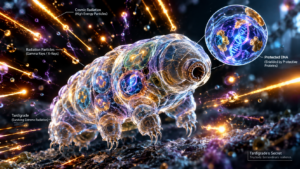
Researchers have identified proteins and cellular mechanisms that may contribute to their ability to repair or protect DNA.
One protein that has received considerable scientific attention is Dsup, short for “damage suppressor.”
Dsup was identified in the tardigrade Ramazzottius varieornatus and has been investigated for its potential role in protecting DNA from radiation-associated damage.
Laboratory studies have explored whether introducing tardigrade-associated protective mechanisms into other cells could improve resistance to certain types of damage.
This does not mean scientists have created indestructible human cells.
Instead, it demonstrates how studying an unusual organism can reveal biological mechanisms that might eventually have practical applications.
The Space Experiment
Tardigrades became even more famous when scientists investigated their ability to withstand conditions associated with space.
Space is an extraordinarily hostile environment.
There is essentially no atmospheric pressure, temperatures can vary dramatically, and radiation levels can be much higher than on Earth’s surface.
Scientists have therefore used tardigrades in experiments designed to investigate biological survival outside Earth’s normal environment.
Some tardigrades have survived exposure to space-related conditions under experimental circumstances.
These experiments are particularly interesting to astrobiology, the scientific field that investigates the origin, evolution, distribution, and future of life in the universe.
The results do not prove that tardigrades could freely live on another planet.
Instead, they demonstrate that certain organisms possess biological characteristics that allow them to tolerate conditions far beyond those experienced by most animals.
Discovery Through Modern Genetics
Modern genetics has transformed tardigrade research.
Early scientists could observe tardigrades under microscopes and test their responses to environmental conditions.
Today, researchers can examine their genomes.
Genome sequencing allows scientists to search for genes associated with stress resistance, DNA repair, metabolism, cellular protection, and other biological processes.
Researchers can compare the genomes of different tardigrade species.
This helps scientists determine whether unusual survival mechanisms evolved once in a common ancestor or appeared independently in different lineages.
Genetic research has also challenged some early assumptions about tardigrades.
Their survival abilities are not controlled by one simple “superpower gene.”
Instead, survival appears to involve complex interactions between genes, proteins, cellular structures, metabolism, and environmental conditions.
Why Are Scientists Studying These Tiny Animals?
At first glance, tardigrades may seem like little more than a biological curiosity.
However, studying them could have much broader implications.
Scientists are interested in whether their cellular protection mechanisms could eventually help humans preserve biological materials.
For example, understanding how cells tolerate dehydration could contribute to research involving the storage of biological samples.
Similar principles could potentially be relevant to preserving cells, proteins, vaccines, or other biological materials.
Tardigrade research may also help scientists understand how life responds to environmental stress.
This could become increasingly important as researchers investigate organisms living in extreme environments on Earth and consider the possibility of life elsewhere.
Could Tardigrades Help Humans Travel Through Space?
This is one of the most exciting possibilities discussed by scientists.
Long-duration space missions create major biological challenges.
Astronauts can be exposed to radiation, isolation, altered gravity, and other stresses.
Researchers are interested in organisms that naturally possess mechanisms for dealing with some of these challenges.
Tardigrades cannot simply be used as a biological shield for astronauts.
However, their molecular mechanisms could provide clues.
If scientists discover exactly how certain tardigrade proteins protect DNA or cellular structures, they may be able to study whether similar protective strategies can be developed for biotechnology.
This remains an active area of research rather than an established medical technology.
The Importance of the Tardigrade’s Environment
Another important discovery is that tardigrades are not normally living in extreme environments.
Many species live in relatively ordinary habitats.
They can be found in moss, lichens, freshwater environments, soil, sediments, and marine ecosystems.
Their extraordinary survival mechanisms are particularly useful because environmental conditions can change dramatically.
A patch of moss can dry out.
Temperature can fall.
Water can disappear.
The tardigrade’s ability to enter a dormant state allows it to survive periods when active life would be extremely difficult.
This provides an important evolutionary lesson.
An organism does not necessarily need to dominate its environment to survive.
Sometimes the best strategy is to wait until the environment becomes favorable again.
What Tardigrades Teach Us About the Limits of Life
Tardigrades have changed scientific discussions about the limits of life.
For a long time, scientists often thought about life in terms of normal metabolic activity.
An organism eats, produces energy, grows, reproduces, and responds to its environment.
Tardigrades demonstrate another possibility.
Life can sometimes enter an almost suspended state in which ordinary biological activity is dramatically reduced.
This raises fascinating questions.
How long can biological systems remain dormant?
What molecular damage accumulates during dormancy?
How does the organism repair itself after rehydration?
Which genes are activated before entering the dormant state?
How did these abilities evolve?
And could similar strategies exist in organisms that scientists have not yet discovered?
Future Research
Tardigrade research is still developing.
Scientists are continuing to discover new species and examine their genomes.
New species may possess survival mechanisms that are different from those already studied.
Advanced microscopy may reveal how tardigrade cells change during dehydration.
Genetic techniques may allow researchers to investigate individual proteins more precisely.
Laboratory experiments can also test how tardigrades respond to combinations of stresses rather than one extreme condition at a time.
This is important because real environments rarely present only one challenge.
An organism may experience dehydration, temperature changes, radiation, pressure, and lack of nutrients simultaneously.
Understanding how tardigrades respond to combinations of environmental stresses could provide an even clearer picture of their remarkable resilience.
The Bigger Discovery
Perhaps the most important discovery associated with tardigrades is not that they are “indestructible.”
They are not.
They can die under sufficiently severe conditions, and survival varies greatly among species and circumstances.
The real scientific discovery is more subtle.
Tardigrades demonstrate that biological systems can evolve sophisticated ways to protect themselves against environmental damage.
Their bodies contain molecular systems that can stabilize cellular structures, protect genetic material, regulate stress responses, and allow them to recover when conditions improve.
This challenges our assumptions about what life can tolerate.
th’s most extreme environments, they may discover other microscopic organisms with equally surprising abilities.
The tardigrade reminds us that life does not always survive by being strong in the conventional sense.
Sometimes survival comes from slowing down, protecting what matters most, and waiting patiently for the world to become livable again.