The Hidden Ocean Beneath Earth’s Surface: A Discovery That Changes Everything
When we imagine an ocean, we usually picture enormous waves, deep blue water, coral reefs, and mysterious creatures living thousands of meters below the surface. But what if one of Earth’s largest reservoirs of water is not an ocean we can see at all?
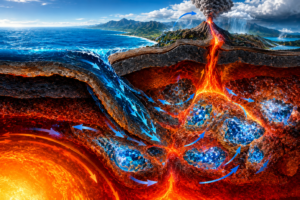
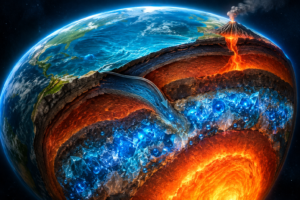
Far beneath our feet, locked inside minerals deep within Earth’s mantle, scientists have discovered evidence of an enormous amount of water. This hidden reservoir is not a conventional underground sea. There are no giant caverns filled with liquid water and no subterranean waves. Instead, water is stored chemically inside rocks and minerals under extreme pressure and temperature.This discovery has changed the way scientists think about Earth’s water cycle, the planet’s interior, and perhaps even the origins of life.
A Water World Hidden Beneath Our Feet
Earth is frequently referred to as the “blue planet” since roughly 71 percent of its surface is covered by oceans. The majority of the water we are familiar with is found in oceans, glaciers, lakes, rivers, groundwater, and the atmosphere.
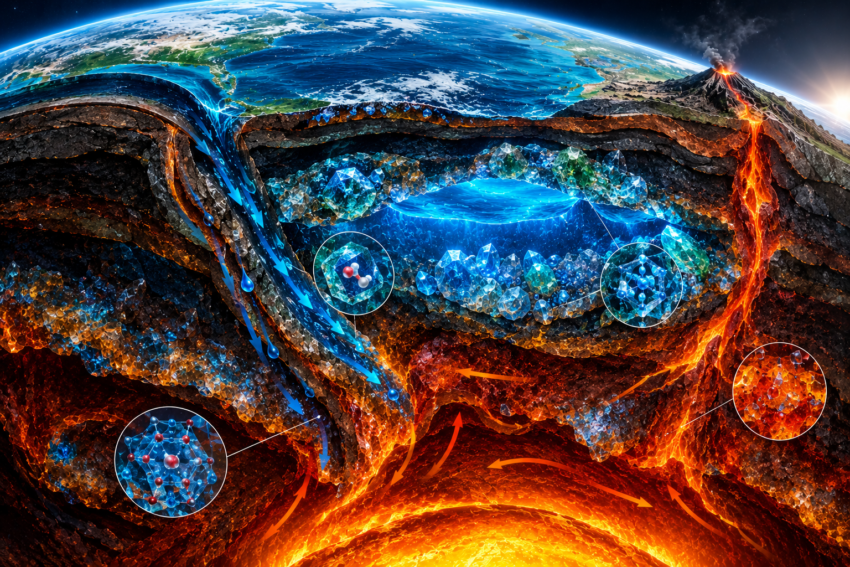
One of the most important clues comes from a mineral called ringwoodite. It exists in a region of Earth’s mantle roughly 410 to 660 kilometers beneath the surface, known as the mantle transition zone.
Under ordinary conditions near Earth’s surface, minerals have particular crystal structures. But the enormous pressure deep inside the planet can force minerals into different forms. Ringwoodite is one of these high-pressure forms.
What makes ringwoodite especially interesting is its ability to hold water within its crystal structure.
That does not mean the mineral is simply soaking up liquid water like a sponge. Instead, hydrogen and oxygen can become incorporated into the mineral’s structure. The water is effectively locked inside the rock at the atomic level.
This creates something extraordinary: a vast hidden reservoir of water spread throughout Earth’s deep interior.
The Discovery of Ringwoodite Changed the Story
For many years, scientists suspected that the mantle transition zone could contain significant amounts of water, but direct evidence was extremely difficult to obtain.
The problem is simple: humans cannot drill hundreds of kilometers into Earth.
The deepest holes ever drilled extend only a tiny fraction of the distance to the mantle. The Earth’s crust itself can be several kilometers thick, while the mantle begins much deeper and extends thousands of kilometers toward the planet’s core.
So how could scientists discover what is happening hundreds of kilometers underground?
They use indirect evidence.
Earthquakes provide one of the most powerful tools.
When an earthquake occurs, it sends seismic waves through the planet. These waves travel at different speeds through different materials. By studying how seismic waves move, bend, slow down, or change direction, scientists can build models of Earth’s internal structure.
Laboratory experiments provide another important clue. Researchers can recreate the extreme pressures and temperatures found deep inside Earth and observe how minerals behave.
These experiments showed that minerals such as ringwoodite can store significant amounts of water.
Then came an extraordinary piece of evidence: a tiny diamond.
The Diamond That Came From Deep Inside Earth
Diamonds are usually associated with jewelry, but to geologists they can be much more than beautiful stones.
Some diamonds form deep within Earth’s mantle and are later carried toward the surface by volcanic processes. Because they can survive extreme conditions, they can act like microscopic time capsules.
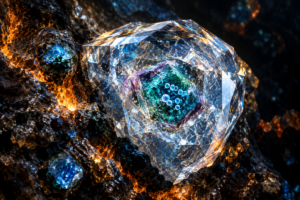
In 2014, researchers studying a diamond found in Brazil discovered something remarkable.
Inside the diamond was a tiny inclusion of ringwoodite.
This was important because it provided direct physical evidence that ringwoodite exists naturally within Earth’s mantle.
Even more fascinating was the fact that the ringwoodite contained water.
The discovery offered scientists a rare glimpse into a part of Earth that is otherwise almost completely inaccessible.
Instead of merely theorizing that water could exist in the mantle transition zone, researchers now had a natural sample showing that it actually happens.
Is There Really an Ocean Down There?
The phrase “hidden ocean” sounds like there is a gigantic underground sea filled with liquid water.
That is not what scientists mean.
The water is primarily bound within minerals. It is not a giant underground lake or an empty cavern stretching across continents.
This distinction is important.
Imagine a huge rock containing water molecules within its chemical structure. The rock may look completely solid and dry, yet its minerals can contain substantial amounts of water.
If enough water is stored this way across a massive region of the mantle, the total amount could become enormous.
Scientists have suggested that the mantle transition zone could potentially contain an amount of water comparable to several of Earth’s surface oceans, depending on how much water is actually stored there.
However, estimates remain uncertain.
The amount of water varies depending on the mineral composition, temperature, pressure, and geological history of different regions.
So it would be misleading to say that scientists have discovered a second ocean beneath Earth.
A better description is that they have found evidence for a massive deep-Earth water reservoir.
How Did the Water Get There?
One of the biggest questions is where this deep water came from.
There are several possibilities.
One explanation involves Earth’s water cycle.
We often think of the water cycle as evaporation, clouds, rain, rivers, and oceans. But Earth’s water cycle may extend far deeper.
Oceanic tectonic plates can sink beneath other plates in a process called subduction.
As one plate moves beneath another, minerals containing water can be carried downward.
Some of this water can eventually be released back toward the surface through volcanic activity. But some may remain trapped deep within Earth’s interior.
This means water could travel between the surface and deep mantle over geological timescales.
The process may have been happening for billions of years.
If so, the Earth’s water cycle is much larger and more complicated than the familiar cycle taught in elementary science.
A Planet With a Deep Water Cycle
The discovery of water in the mantle has changed the way scientists think about Earth’s long-term evolution.
Water does not simply sit on the surface.
It moves.
Rain falls from the atmosphere. Rivers carry water to oceans. Oceanic plates interact with the seafloor. Subduction carries minerals and water downward. Volcanic activity can release water and gases back toward the surface.
This creates a deep planetary cycle involving the atmosphere, oceans, crust, and mantle.
The mantle could therefore act as a giant storage system.
This has important consequences for understanding why Earth has maintained oceans for such an extraordinarily long period.
Earth’s surface environment has changed dramatically throughout its history. Continents have moved. Mountains have risen and eroded. Ice ages have come and gone. Volcanoes have reshaped the planet.
Yet liquid water has remained a defining feature of Earth.
The deep mantle may have played an important role in helping regulate the amount of water available at the surface.
Could the Hidden Water Affect Earth’s Oceans?
Possibly.
If water is continuously transported into and out of Earth’s interior, the deep mantle could influence the amount of water present on the surface over geological time.
Imagine Earth’s water as being divided among several reservoirs.
There is water in the oceans, atmosphere, glaciers, groundwater, rocks, and deep mantle.
If the balance between these reservoirs changes, the amount of water at the surface could change as well.
This could influence sea levels, volcanic activity, climate, and the chemical composition of the oceans.
Scientists are still working to understand exactly how large this effect might be.
The discovery does not mean Earth’s oceans will suddenly disappear underground. These processes generally occur over extremely long geological timescales.
But they may have influenced the planet’s history in ways we are only beginning to understand.
What Does This Mean for Volcanoes?
Water stored deep inside Earth can also influence volcanic activity.
When tectonic plates descend into the mantle, water-bearing minerals can become unstable under changing temperature and pressure. Water may be released into surrounding rock.
This can help lower the melting temperature of mantle materials.
In simple terms, water can make it easier for certain rocks to melt.
The resulting magma can eventually rise toward the surface and contribute to volcanic activity.
This means that water hidden hundreds of kilometers underground may indirectly help fuel volcanoes.
Every volcanic eruption, therefore, could be connected to processes occurring far deeper than we can directly observe.
Could This Discovery Help Explain Life?
Water is one of the most important ingredients for life as we know it.
That naturally raises another fascinating question: could deep-Earth water have played a role in the origin or survival of life?
Scientists do not currently have evidence that life exists hundreds of kilometers beneath Earth’s surface in the mantle transition zone.
However, Earth’s deep underground environment does contain microbial life in shallower regions, and researchers have discovered organisms living in places once thought too extreme for life.
These discoveries have expanded our understanding of where life can survive.
The deep Earth also contains chemical energy sources that could potentially support microorganisms.
Although the hidden water in the mantle should not be confused with a secret ecosystem, studying Earth’s interior may help scientists understand how water, minerals, heat, and chemical energy interact.
That knowledge could become especially valuable when scientists study other worlds.
What About Other Planets?
The discovery has implications far beyond Earth.
Scientists have long wondered why Earth developed such a stable environment for liquid water while other planets evolved differently.
Mars, for example, shows strong evidence that it once had rivers, lakes, and perhaps large bodies of water on its surface. Today, however, its surface is cold and dry.
Could some of Mars’s ancient water have moved underground or become locked inside minerals?
Scientists are investigating similar possibilities.
Understanding Earth’s deep water cycle could help researchers interpret evidence from Mars and other rocky worlds.
It may also influence how we search for habitable environments beyond our planet.
A planet does not necessarily need to have enormous surface oceans to contain significant amounts of water.
Water could be stored underground, inside rocks, beneath ice, or within minerals.
This expands the number of places scientists might consider when searching for environments capable of supporting life.
A Reminder of How Little We Know
Perhaps the most remarkable part of this discovery is not simply the amount of water involved.
It is the realization that Earth is still full of secrets.
Human civilization has mapped much of the planet’s surface. Satellites can photograph remote deserts, forests, mountains, and oceans. Submersibles can explore parts of the deep sea.
Yet Earth’s interior remains almost completely inaccessible.
We know more about some distant astronomical objects than we do about the deepest parts of our own planet.
Every earthquake gives scientists another opportunity to study the interior. Every unusual diamond can provide another clue. Every laboratory experiment can reveal how minerals behave under unimaginable pressures.
Piece by piece, researchers are constructing a picture of the hidden Earth.
Could the Deep Water Ever Reach the Surface?
Yes, but usually through slow geological processes.
Water stored in mantle minerals can be released under certain conditions. Volcanic activity is one pathway by which materials from Earth’s interior eventually reach the surface.
Tectonic movements can also bring deep materials upward.
However, these processes happen over timescales that are enormous compared with human lifetimes.
A person might watch a river change course within decades. A mountain can erode over thousands or millions of years.
Deep-Earth processes can take millions or even hundreds of millions of years.
This reminds us that Earth operates on multiple timescales.
The world we experience every day is only the surface expression of a much larger geological system.
The Future of Deep-Earth Research
Scientists are continuing to investigate exactly how much water is stored inside Earth’s mantle and how it moves through the planet.
Future research may combine seismic measurements, laboratory experiments, mineral physics, volcanic rocks, and diamonds brought naturally from deep within Earth.
Improved technology could also provide better models of Earth’s interior.
Researchers may eventually determine whether certain regions contain more water than others and how much water moves between the surface and mantle over geological time.
These answers could help explain major questions about Earth’s history.
Why did Earth’s oceans remain stable?
How did the planet’s atmosphere evolve?
How has volcanic activity changed through time?
How did tectonic plates begin interacting with Earth’s water?
And perhaps most intriguingly, how did the planet become such a favorable home for life?
The answers may be connected to the hidden water deep below us.
The Ocean We Cannot See
Earth’s hidden water reservoir is a powerful reminder that discoveries do not always require finding something completely new.
Sometimes the greatest discoveries come from looking at something familiar in a completely different way.
Water has always been part of Earth’s story.
We see it in oceans, rain, snow, rivers, clouds, and ice. But beneath those familiar forms is another world where water becomes part of minerals, travels with tectonic plates, interacts with rocks, and participates in geological processes that operate over millions of years.
The “hidden ocean” beneath Earth is not an underground sea waiting to be explored by submarines.
It is something stranger and perhaps more fascinating: water incorporated into the very structure of our planet.
And that discovery changes our understanding of Earth.
It suggests that the planet’s water cycle reaches far deeper than we imagined, that Earth’s interior may help regulate its surface environment, and that the history of water and life may be inseparable from the hidden processes occurring beneath our feet.
Every glass of water we drink is part of a planetary story that may stretch from the atmosphere to the deepest regions of Earth’s mantle.
The next time you look at the ocean, remember that what you see may represent only one part of Earth’s enormous water system.
There may be another vast reservoir hidden hundreds of kilometers below the surface—silent, invisible, and locked inside the rocks that form our planet.
And scientists are only beginning to understand it.