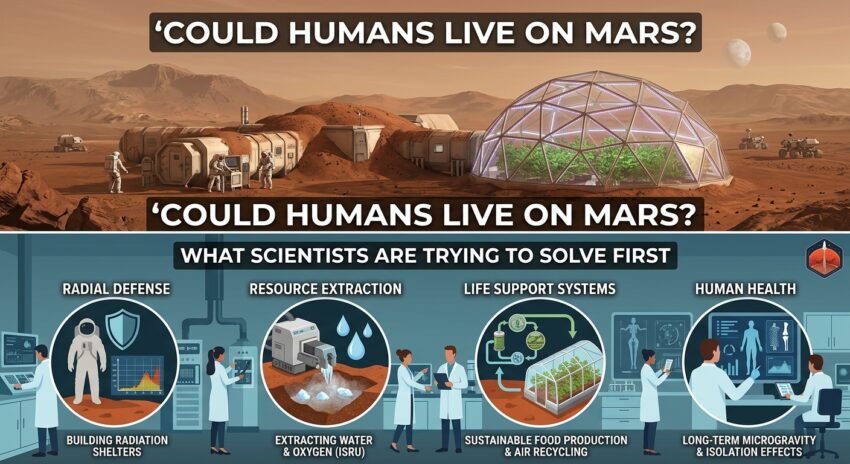
Mars has fascinated scientists and space enthusiasts for generations. The red planet is relatively close to Earth, has water ice, a day only slightly longer than ours, and a surface that scientists can study with increasingly sophisticated spacecraft and robots.
These similarities make Mars one of the most interesting places to consider for future human exploration. But there is a huge difference between visiting Mars and living there.
A human settlement on Mars would face extreme cold, radiation, low atmospheric pressure, limited water, dangerous dust, and enormous logistical challenges. Astronauts would also need reliable food, oxygen, shelter, electricity, medical care, and a way to repair equipment millions of kilometers from Earth.
So, could humans actually live on Mars?
Possibly—but not in the way we live on Earth.
Scientists are investigating technologies that could allow astronauts to survive for increasingly long periods on Mars. However, many of the biggest challenges remain unsolved.
Mars Is Not Naturally Habitable for Humans
Mars may look somewhat familiar in photographs, but its environment is extremely hostile to humans.
The planet has a very thin atmosphere dominated by carbon dioxide. Earth’s atmosphere, by comparison, is mostly nitrogen and oxygen, with enough atmospheric pressure to support human life at the surface.
On Mars, the atmospheric pressure is less than 1% of Earth’s average sea-level pressure. A person standing unprotected on the Martian surface would therefore need a pressurized spacesuit or another life-support system.
Mars is also much colder than Earth. Average surface temperatures are far below freezing, although temperatures vary significantly depending on location and time of day.
The planet’s atmosphere is too thin to provide humans with breathable oxygen or sufficient protection from the space environment.
This means future settlers could not simply land on Mars, open a spacecraft door, and walk outside.
They would need to live inside carefully engineered habitats.
The First Major Problem: Oxygen
Humans need oxygen continuously. Carrying all the oxygen required for a permanent settlement from Earth would be extremely difficult.
Fortunately, Mars provides a potentially useful resource: its atmosphere contains carbon dioxide.
Scientists have already demonstrated technology capable of extracting oxygen from Martian atmospheric carbon dioxide.
NASA’s Mars Oxygen In-Situ Resource Utilization Experiment, known as MOXIE, was carried aboard the Perseverance rover. During its experiments, MOXIE successfully produced oxygen from the Martian atmosphere.
This demonstration was important because it showed that future missions may be able to manufacture some of the resources astronauts need instead of transporting everything from Earth.
A larger future system could potentially produce oxygen for astronauts to breathe and, in principle, contribute oxygen for rocket propellant.
However, producing oxygen on the scale required for a human settlement would be far more difficult than operating a small experimental instrument.
Future systems would need to operate reliably for long periods, consume energy, survive the harsh Martian environment, and be repairable.
Water Could Be the Key Resource
Water is perhaps even more important than oxygen.
Humans need water for drinking, food preparation, hygiene, agriculture, and many industrial processes. Water can also be separated into hydrogen and oxygen, potentially providing ingredients for rocket propellant.
Scientists have strong evidence that Mars contains water ice, particularly in underground and polar regions.
The challenge is finding accessible water that future astronauts can extract economically and safely.
A settlement could potentially use local ice rather than transporting huge quantities of water from Earth.
This idea is part of a broader concept known as in-situ resource utilization, or ISRU.
The basic idea is simple: instead of taking everything from Earth, astronauts use materials already available at their destination.
On Mars, this could mean extracting water from ice or soil, producing oxygen from the atmosphere, and eventually using local materials for construction.
The more resources astronauts can obtain locally, the less they would need to transport from Earth.
Radiation Is a Serious Challenge
Earth has a powerful natural defense against much of the radiation coming from space.
Mars does not have the same level of global protection.
The planet has a thin atmosphere and lacks Earth’s strong global magnetic field. As a result, astronauts on Mars would be exposed to more radiation than people living on Earth.
Long-term exposure to space radiation can increase health risks.
This creates a major engineering problem: How can habitats protect astronauts without becoming impossibly heavy?
One possible solution is to place habitats underground or cover them with thick layers of Martian soil, known as regolith.
Underground environments could provide additional shielding from radiation and also help protect astronauts from extreme temperature changes and dust storms.
Another possibility is to construct protective walls using locally available Martian materials.
Scientists are studying different approaches, but designing practical long-term radiation protection remains an important challenge.
Mars Needs a Safe Home
A future Mars habitat would need to function almost like a miniature artificial Earth.
Inside the habitat, astronauts would need controlled temperature, atmospheric pressure, oxygen levels, humidity, water recycling, waste management, electricity, and protection from radiation.
A failure in one major system could become life-threatening.
For this reason, future habitats would probably need extensive redundancy.
If one oxygen-generation system failed, another system might need to take over. If a water-processing system stopped working, astronauts would need backup supplies.
The habitat would also need to withstand pressure differences between the inside and outside.
Scientists and engineers are studying different habitat concepts, including rigid structures, inflatable systems, underground habitats, and structures made partly from local materials.
The exact design remains an open engineering question.
How Would Mars Settlers Get Food?
Food is another enormous challenge.
The first astronauts could bring most of their food from Earth. But a long-term settlement would eventually need some form of local food production.
Growing plants on Mars would not be as simple as planting seeds in Martian soil.
Martian soil contains compounds and physical characteristics that make direct agriculture difficult. Plants would also need water, nutrients, controlled temperatures, light, and an appropriate atmosphere.
Instead, future settlements could use enclosed growing systems.
Hydroponics, controlled-environment agriculture, and other techniques could allow crops to grow without relying entirely on untreated Martian soil.
LED lighting could provide the necessary light inside habitats.
Recycling would also be extremely important. Water and nutrients could potentially be recovered from waste streams rather than constantly imported from Earth.
Researchers are studying which crops could provide useful combinations of calories, nutrients, and efficient growth.
Where Would the Electricity Come From?
Every major Mars system would require energy.
Electricity would be needed for heating, lighting, communications, water processing, oxygen production, agriculture, scientific experiments, computers, and machinery.
Solar power is an obvious option because Mars receives sunlight.
However, Mars is farther from the Sun than Earth, and dust can reduce the amount of sunlight reaching solar panels. Large dust storms could create additional difficulties.
For this reason, future settlements might require multiple energy sources.
Nuclear power is one potential option because it can provide electricity without depending directly on sunlight. Small nuclear power systems have been studied for future lunar and Martian missions.
A combination of nuclear and solar power could provide greater resilience than relying entirely on one source.
The ability to maintain a stable power supply could become one of the most important requirements for a permanent settlement.
Mars Dust Could Cause Problems
Mars is famous for its reddish dust.
The dust is extremely fine and can become airborne during storms. It can settle on solar panels, machinery, spacesuits, seals, and other equipment.
A future settlement would need ways to prevent dust from entering living areas.
Spacesuits could potentially be stored or cleaned in dedicated areas before astronauts enter habitats.
Equipment would also need to be designed to operate in dusty conditions.
Large regional dust storms can sometimes affect huge portions of the planet, making dust management an important consideration for future missions.
The Journey to Mars Is Difficult Too
Even reaching Mars is a major challenge.
Mars and Earth orbit the Sun at different speeds and distances. Spacecraft therefore cannot simply point directly at Mars and travel in a straight line.
Missions are planned around favorable launch windows when the positions of Earth and Mars make the journey more practical.
A crewed mission would involve months of travel.
During the journey, astronauts would experience microgravity and radiation exposure. They would also be confined to a relatively small spacecraft for an extended period.
This means spacecraft would need life-support systems capable of operating reliably for months.
Crew health would also need careful management.
What Happens If Something Breaks?
On Earth, a broken machine can often be repaired using tools and replacement parts delivered relatively quickly.
Mars is different.
Communication between Earth and Mars takes time because of the enormous distance between the planets. Depending on their positions, signals can take several minutes to travel one way.
Astronauts therefore cannot depend on real-time conversations with mission control for every problem.
Future crews would need to be highly autonomous.
They would require extensive technical training and the ability to diagnose and repair equipment themselves.
Robots could also become important assistants.
Before humans arrive, robotic systems could potentially prepare landing areas, inspect equipment, locate resources, and help construct infrastructure.
Could Mars Eventually Become Like Earth?
This idea is often called terraforming.
Terraforming Mars would mean changing its environment on an enormous scale to make it more suitable for Earth-like life.
Popular science fiction sometimes imagines humans warming Mars, thickening its atmosphere, and eventually creating oceans and breathable air.
In reality, terraforming would be an extraordinarily difficult project.
Mars has a thin atmosphere, low temperatures, and environmental conditions very different from Earth. Transforming the planet would require technologies and resources far beyond anything currently available.
Scientists therefore generally focus on a much more realistic near-term concept: creating small, controlled human environments on Mars rather than transforming the entire planet.
Instead of making Mars Earth-like, humans would bring Earth-like conditions with them.
Robots May Arrive Before Humans
Robots are likely to play an important role in future Mars exploration.
Robotic spacecraft can operate without food, oxygen, or human-sized living spaces.
They can spend years traveling through space and exploring dangerous environments.
Future robots could potentially perform tasks such as mapping resources, moving equipment, preparing construction sites, and testing systems before astronauts arrive.
This could reduce some risks associated with early human missions.
A human Mars settlement might therefore begin with a long period of robotic preparation.
How Close Are We?
Scientists have already demonstrated several technologies relevant to future human exploration.
Robotic spacecraft have successfully operated on Mars for years. Scientists have detected water ice and studied the planet’s atmosphere and geology. Experiments such as MOXIE have demonstrated oxygen production from Martian atmospheric carbon dioxide.
But these achievements represent individual pieces of a much larger puzzle.
A permanent human settlement would require many systems to work together reliably for years.
The challenge is not simply landing humans on Mars.
The bigger challenge is keeping them alive.
What Would the First Mars Settlement Look Like?
The earliest settlement would probably not resemble a city.
It could be a small collection of interconnected pressurized habitats, laboratories, power systems, storage areas, communication equipment, and machines.
Astronauts might spend much of their time inside protected structures.
Robots could operate outside for extended periods, while humans would venture out in spacesuits when necessary.
Over time, additional habitats could be added.
More powerful energy systems could be installed. Food production could expand. Resource extraction could become more efficient.
If these technologies became reliable enough, the settlement could gradually become more independent from Earth.
However, this would likely be a long process rather than a sudden transformation.
So, Could Humans Live on Mars?
The scientific answer is possibly, but only with extensive technology and infrastructure.
Mars does contain resources that could potentially support human missions, particularly water ice and atmospheric carbon dioxide. Scientists have already demonstrated some technologies for using local resources.
But major challenges remain.
Humans would need protection from radiation, reliable oxygen and water systems, food production, dependable electricity, pressurized habitats, dust management, medical capabilities, spare parts, and highly reliable life-support technology.
The most realistic vision of early human life on Mars is therefore not people walking around an Earth-like planet.
It is people living inside carefully engineered habitats while robots and machines operate outside.
Mars would remain a hostile environment, but humans could potentially create small pockets of safety within it.
The Bigger Question
The Mars challenge is ultimately about more than reaching another planet.
It is a test of how much humans can learn to produce, recycle, repair, and manage using limited resources far from Earth.
If scientists can develop reliable systems for oxygen, water, food, energy, construction, and radiation protection, Mars could eventually become a place where humans spend extended periods.
Whether that develops into a permanent settlement is still an open question.
For now, Mars remains a world of scientific exploration—and one of the biggest engineering challenges humanity has ever considered.