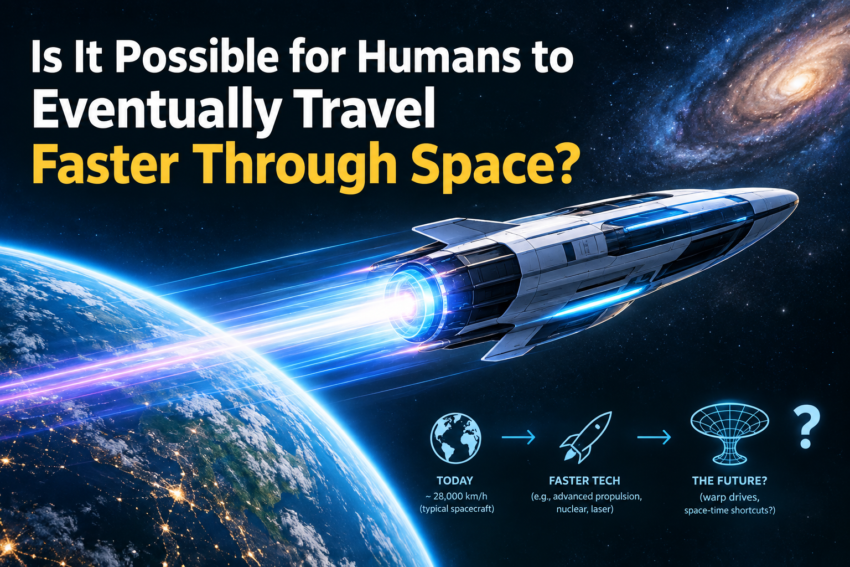
Is It Possible for Humans to Eventually Travel Faster Through Space?
Imagine looking up at the night sky and knowing that the stars are not just distant points of light. They are other suns, surrounded by planets, and some may even have conditions that could potentially support life.
Now imagine being able to travel to one of them.
Today, that sounds almost impossible. The distances between stars are enormous, and even our fastest spacecraft would require thousands or millions of years to reach many destinations outside our solar system.
But could humans eventually develop spacecraft capable of traveling much faster than today’s technology?
Could we one day travel to other star systems within a human lifetime?
And could science eventually find a way to move through space at a significant fraction of the speed of light?
The response is not a straightforward yes or no.Physics as we know it imposes extraordinary constraints on how quickly matter can move. Based on Einstein’s theory of relativity, a thing that has mass cannot just speed up through space until it hits the speed of light
However, scientists have proposed several theoretical technologies that could allow spacecraft to travel much faster than today’s rockets.
Some ideas involve powerful nuclear propulsion. Others involve antimatter, fusion, light sails, or even manipulating spacetime itself.
The future of space travel could therefore be very different from the chemical rockets we use today.
Why Is Space Travel So Slow?
The biggest problem is not necessarily the speed of a spacecraft.
It is the enormous size of space.
The Moon lies roughly 384,400 kilometers away from Earth. A spacecraft is able to get there within days.
Mars sits far farther off, and how long the trip takes hinges on where Earth and Mars are positioned and which trajectory is chosen.
Yet once we venture beyond the solar system, the distances turn nearly impossible to imagine.
The nearest star system to the Sun, Alpha Centauri, is more than four light-years away.
One light-year is the distance light travels in one year—about 9.46 trillion kilometers.
That means Alpha Centauri is roughly 40 trillion kilometers away.
Even traveling at speeds far beyond today’s spacecraft would still make interstellar travel extremely difficult.
This is why future space travel requires more than simply building a slightly faster rocket.
We may need entirely new propulsion technologies.
The Speed of Light Is a Fundamental Limit
One of the biggest obstacles comes from Einstein’s theory of special relativity.
Light travels through empty space at approximately 300,000 kilometers per second.
According to our current understanding of physics, objects with mass cannot be accelerated to the speed of light.
As an object with mass approaches light speed, increasingly more energy is required to accelerate it further.
Reaching exactly the speed of light would require an effectively infinite amount of energy under conventional relativistic physics.
So a spacecraft carrying humans is not expected to simply accelerate until it reaches the speed of light.
But there is an important distinction.
We may not need to reach the speed of light to make interstellar travel practical.
Traveling at even a significant fraction of light speed could dramatically reduce travel times.
What Would Happen at Near-Light Speed?
Suppose a future spacecraft could travel at 90% of the speed of light.
From Earth’s perspective, reaching a star four light-years away would still take several years.
But something strange would happen to the travelers.
According to special relativity, time passes differently for objects moving at extremely high speeds relative to an observer.
This effect is called time dilation.
For people traveling close to the speed of light, less time would pass on the spacecraft than for people remaining on Earth.
This means a crew could potentially experience a shorter travel time than people watching from Earth.
However, time dilation does not make the distance disappear.
The spacecraft would still need enormous energy to reach such speeds.
And slowing down at the destination would require another enormous energy expenditure.
Could Nuclear Rockets Make Spacecraft Much Faster?
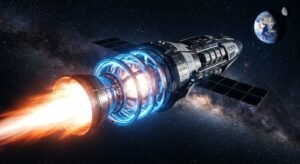
One possible path toward faster space travel is nuclear propulsion.
Traditional rockets burn chemical fuel. Chemical reactions can produce enormous amounts of energy, but their energy density is limited.
Nuclear reactions can release vastly more energy.
There are two major possibilities: nuclear fission and nuclear fusion.
Nuclear Fission
Fission is the process of splitting heavy atomic nuclei, for example uranium.
On Earth, nuclear reactors already produce electricity through this process.
A nuclear thermal rocket could employ a reactor to heat a propellant and expel it at high speed.
This might offer considerably higher efficiency than traditional chemical rockets.
Nuclear-electric propulsion is another approach, where a reactor generates electricity to power an electric propulsion system.
These technologies could significantly improve deep-space missions, although they would not automatically allow spacecraft to travel anywhere near the speed of light.
Could Nuclear Fusion Power Interstellar Spacecraft?
Fusion is even more exciting.
Fusion takes place when light atomic nuclei merge to create heavier nuclei, releasing energy in the process.
The Sun generates its energy by means of nuclear fusion.
Researchers are striving to achieve controlled fusion here on Earth, even though building a practical fusion power system is still extraordinarily difficult.
Should engineers of the future manage to construct compact and highly efficient fusion propulsion systems, they could possibly make far faster spacecraft a reality.
A fusion-powered spacecraft could theoretically reach a meaningful fraction of the speed of light under suitable designs.
That would change interstellar exploration.
Instead of taking tens of thousands of years to cross between nearby stars, a sufficiently advanced spacecraft could potentially make some journeys within decades.
However, this remains a technological possibility rather than an established engineering capability.
Could Antimatter Be the Ultimate Rocket Fuel?
Another theoretical propulsion concept involves antimatter.
Antimatter is unusual because when matter and antimatter meet, they can annihilate, converting much of their mass into energy.
This makes antimatter extremely energy-dense.
In principle, antimatter could provide an enormous amount of energy for propulsion.
But there is a huge problem.
Producing antimatter is extraordinarily difficult and expensive, and storing it safely is also extremely challenging.
Antimatter cannot simply be placed inside an ordinary fuel tank.
It must be isolated from normal matter because contact causes annihilation.
At present, antimatter propulsion is far beyond practical spacecraft engineering.
But if future civilizations developed dramatically better ways to produce and store antimatter, it could become an important possibility for extremely fast spacecraft.
Could Laser Sails Carry Spacecraft to Other Stars?
One of the most interesting concepts does not require carrying large quantities of fuel at all.
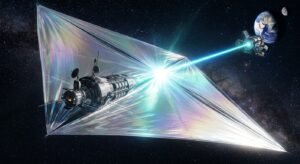
It is called a light sail or laser sail.
Light carries momentum.
When photons interact with a reflective surface, they can exert a tiny force.
Normally, this force is extremely small.
But if a spacecraft has an extremely lightweight sail and is pushed by a powerful laser beam from Earth or another location, the force could gradually accelerate it.
Because the spacecraft does not need to carry its main propulsion system as fuel, it could potentially reach very high speeds.
Researchers have proposed concepts involving tiny spacecraft accelerated by powerful laser arrays.
The challenge is enormous.
The laser system would need to deliver tremendous power, the sail would have to be extremely lightweight and durable, and the spacecraft would need a way to survive high-speed impacts with dust and particles.
There is also the problem of slowing down when the spacecraft reaches another star system.
Still, laser propulsion is one of the more scientifically interesting approaches to interstellar travel.
What About Warp Drives?
Now we enter the most speculative territory.
A warp drive sounds like something from science fiction.
But the idea has a basis in general relativity.
Einstein’s theory describes space and time as parts of a flexible structure called spacetime.
Gravity itself can be understood as the curvature of spacetime.
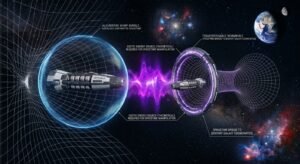
In the 1990s, physicist Miguel Alcubierre proposed a mathematical model in which a spacecraft could theoretically travel inside a “warp bubble.”
Instead of the spacecraft locally moving faster than light, space itself would be compressed in front of the spacecraft and expanded behind it.
The spacecraft would effectively be carried by the changing geometry of spacetime.
This is extremely different from simply building a faster engine.
However, the original concept involves extraordinary physical requirements and unresolved problems.
Some versions of warp-drive concepts require forms of energy or matter with properties that have not been demonstrated in the required quantities.
Therefore, warp drives remain theoretical.
There is currently no known engineering method for building one.
Could Wormholes Provide Shortcuts Through Space?
Another possibility comes from general relativity: wormholes.
A wormhole can be imagined as a shortcut connecting two distant regions of spacetime.
Instead of traveling across the enormous distance between two stars, a spacecraft could theoretically enter one side of a wormhole and emerge somewhere far away.
The concept is mathematically interesting, but there is currently no evidence that traversable wormholes exist.
Keeping a hypothetical wormhole open may also require unusual forms of matter or energy.
Scientists therefore do not currently know whether naturally occurring or artificially created traversable wormholes are possible.
For now, wormholes belong primarily to theoretical physics rather than practical space engineering.
The Problem of Energy
One of the biggest challenges facing extremely fast space travel is energy.
Acceleration requires energy.
The faster the spacecraft becomes, the more difficult acceleration becomes under relativity.
A spacecraft carrying humans would also need life-support systems, radiation protection, navigation equipment, food, water, communications systems, and structural protection.
And the spacecraft would need to slow down when it reaches its destination.
That means interstellar travel is not simply a matter of achieving high speed.
The entire mission must be designed around energy generation, storage, propulsion, acceleration, braking, and safety.
Space Dust Becomes Dangerous at High Speed
At ordinary spacecraft speeds, tiny particles of dust may appear harmless.
At relativistic speeds, they become extremely dangerous.
Imagine a microscopic particle hitting a spacecraft while both are moving at a significant fraction of the speed of light.
The energy released could be enormous.
Even tiny particles could damage spacecraft structures.
Future interstellar spacecraft would therefore need advanced shielding.
Scientists might investigate layered materials, sacrificial shields, magnetic protection, or other technologies.
A successful interstellar spacecraft would need to survive not only the vacuum of space but also the high-energy environment created by traveling through interstellar material at extreme velocity.
Radiation Is Another Major Problem
Space is also filled with radiation.
Astronauts outside Earth’s protective atmosphere and magnetic field can experience increased exposure to high-energy particles.
The problem becomes even more serious for long-duration interstellar missions.
A spacecraft traveling for decades would need substantial radiation protection.
Heavy shielding can help, but heavy shielding also increases spacecraft mass.
This creates another engineering trade-off.
Future technologies may need lightweight materials that provide strong radiation protection without making spacecraft impossibly massive.
Could Artificial Intelligence Help?
Artificial intelligence could play an important role in future high-speed space travel.
Interstellar spacecraft could be far from Earth, creating communication delays.
A spacecraft traveling to another star cannot wait for Earth to provide instructions for every problem.
AI systems could potentially monitor spacecraft systems, identify failures, manage energy, navigate, and make decisions when communication with Earth is delayed.
Robotic spacecraft may therefore become the first explorers to travel between stars.
They could test propulsion systems, study distant planets, and determine whether environments are suitable for future human missions.
Will Humans Ever Reach Another Star?
It is impossible to give a reliable date.
Human interstellar travel remains far beyond current capabilities.
But that does not mean it is scientifically impossible under every conceivable future technology.
If humanity develops powerful propulsion systems capable of reaching a significant fraction of light speed, nearby star systems could become physically reachable within human timescales.
The challenge is developing the technology, energy infrastructure, materials, shielding, life-support systems, and economic resources required.
The first interstellar missions may therefore be very different from science-fiction starships.
They could begin with tiny robotic spacecraft.
Later missions might become larger.
Eventually, if technological progress continues for centuries, human missions could become possible.
Could Humans Travel Faster Than Light?
This is the ultimate question.
Based on current physics, objects with mass cannot simply accelerate through space faster than light.
There are theoretical ideas involving spacetime manipulation, such as warp-drive concepts and wormholes, but these remain speculative.
No experiment has demonstrated a method for sending a spacecraft faster than light.
Therefore, faster-than-light human travel should not currently be treated as an achievable technology.
But science has repeatedly shown that our understanding of nature can develop.
That does not mean every science-fiction idea will become real.
It means that future discoveries could reveal new possibilities—or confirm that certain limits are fundamental.
What Could Space Travel Look Like 100 or 200 Years From Now?
The future may not involve one revolutionary invention.
Instead, progress could happen through many smaller advances.
Better nuclear propulsion could reduce travel times within the solar system.
Advanced materials could make spacecraft lighter and stronger.
Reusable launch systems could reduce the cost of reaching orbit.
Artificial intelligence could make autonomous spacecraft more capable.
Fusion research could eventually produce new propulsion options.
Laser technology could enable powerful light-sail systems.
Better radiation shielding could make long missions safer.
Together, these developments could gradually transform space travel.
The Future of Human Space Travel
Humanity is still at the beginning of its spacefaring history.
We have sent spacecraft to every major region of the solar system.
We have landed robots on Mars.
We have studied distant planets around other stars.
But traveling to another star remains an enormous challenge.
The distances are so great that today’s propulsion systems are simply not designed for interstellar journeys.
Future generations may need to think about space travel differently.
Instead of asking how to make today’s rockets slightly faster, scientists may need to develop completely new methods of propulsion.
Nuclear fusion, laser sails, advanced electric propulsion, antimatter, and theoretical spacetime engineering all represent different possibilities.
Some may fail.
Some may prove impractical.
Others may eventually become important technologies.
Final Thoughts
Can humans eventually travel faster through space?
Very likely faster than we can travel today—but whether humans can travel at a significant fraction of the speed of light remains an enormous technological challenge.
Chemical rockets are powerful enough to explore our solar system, but they are poorly suited to interstellar travel.
Future propulsion systems could potentially use nuclear energy, fusion, antimatter, powerful lasers, or other technologies to achieve much higher speeds.
Meanwhile, theoretical concepts such as warp drives and wormholes challenge us to think about whether the geometry of spacetime itself could eventually be used for transportation.
For now, these ideas remain separated into two categories.
Some technologies, such as advanced nuclear propulsion and light sails, are based on known physical principles but face major engineering challenges.
Others, such as practical warp drives and traversable wormholes, remain highly speculative.
The most important point is that space is enormous.
Even traveling incredibly fast does not make the universe small.
But if humanity continues developing better propulsion, materials, energy systems, robotics, and life-support technologies, journeys that seem impossible today could become engineering problems for future generations.
Perhaps one day, a spacecraft will leave Earth, accelerate to an extraordinary speed, and begin a journey toward another star.
And when that happens, humanity will have crossed a boundary that has existed for all of our history—the boundary between being a civilization trapped around one star and becoming a species capable of traveling between the stars.