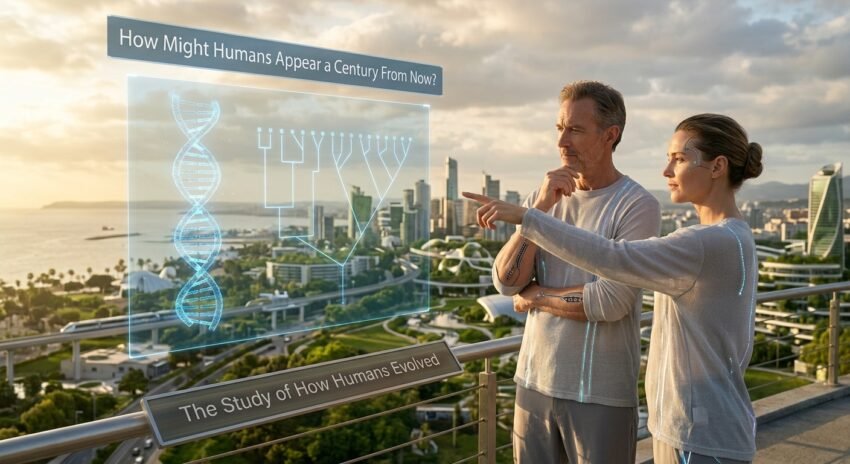
How Might Humans Appear a Century From Now? The Study of How Humans Evolved
What will humans look like 100 years from now?
Will people become taller, thinner, stronger, or perhaps even look noticeably different from humans today?
Science fiction often imagines future humans with enormous eyes, strange-shaped heads, tiny bodies, or even completely redesigned appearances. But real human evolution is likely to be much more complicated—and much less dramatic.
Humans are still evolving today. However, evolution does not follow a predetermined plan. It does not try to make organisms “better,” and it does not know what humans will look like in the future.
Evolution happens when genetic variation, reproduction, environmental pressures, random genetic changes, and other factors gradually change populations over generations.
At the same time, modern humans are changing the environment around themselves faster than almost any previous generation.
Medicine, technology, urbanization, global travel, changing diets, climate, and reproductive choices can all influence the conditions under which human populations evolve.
So what might humans look like in the year 2126?
The honest answer is that scientists cannot predict our exact appearance. But by examining how human evolution works today, we can explore some fascinating possibilities.
Are Humans Still Evolving?
Yes, Human evolution did not stop when early humans developed agriculture, built cities, or invented modern technology.
Our species continues to experience genetic changes.Some genetic variants can become more common or less common in populations over generations because of natural selection, genetic drift, migration, and other evolutionary processes.
Researchers have identified relatively recent human adaptations involving areas such as immunity, metabolism, diet, and the ability to live at high altitudes.
However, evolution generally operates across many generations.
One hundred years is only around four generations for a population with a generation time of roughly 25 years.
That is a very short period from an evolutionary perspective.Therefore, dramatic changes to the average human appearance over only a century would require unusually strong evolutionary pressures or technological intervention.
Evolution Does Not Have a Destination
One common misunderstanding is that evolution is always pushing humans toward a particular form.
It isn’t.
There is no biological blueprint saying that future humans must become taller, smarter, stronger, or more attractive.
Evolution simply describes changes in inherited characteristics within populations.
A characteristic becomes more common when circumstances cause its associated genetic variants to be passed on more frequently.
That means the future of human evolution depends partly on what happens to human societies.
If environments change, different traits may become more or less useful.
If medicine changes survival and reproduction, natural selection can operate differently.
If people increasingly choose partners for cultural or personal reasons, those choices can also influence which genetic variants are passed to future generations.
Could Humans Become Taller?
Height is influenced by many genes as well as nutrition, childhood health, and environmental conditions.
In some populations, average height has increased substantially over the last few centuries.
However, this does not necessarily mean humans are undergoing a simple evolutionary transformation toward greater height.
Improved nutrition and healthcare can produce taller bodies without requiring major genetic changes.
Over the next century, human height could continue to change in some populations, but predicting a universal increase would be unjustified.
Different populations could follow different trajectories depending on nutrition, disease, living conditions, genetics, and reproductive patterns.
Could Humans Become Smaller?
The opposite is also possible.
If environmental or social conditions changed in ways that favored smaller bodies, evolutionary pressures could theoretically move populations in that direction.
Body size affects energy requirements, heat loss, physical strength, and many other biological characteristics.
But there is currently no scientific basis for confidently predicting that future humans will become smaller overall.
Human evolution is not simply a process of becoming larger or smaller.
Different traits can change independently or interact with one another.
Will Humans Have Bigger Brains?
This is one of the most popular future-human ideas.
Science fiction often depicts future humans with enormous heads and extremely large brains.
But bigger does not automatically mean better.
The human brain is already an extremely energy-demanding organ.
The brain consumes a substantial amount of the body’s energy despite representing only a small fraction of body mass.
A larger brain would require additional energy and would create developmental and physical trade-offs.
Furthermore, intelligence is not determined simply by brain size.
The organization of neural networks, connectivity, development, genetics, and environment all matter.
There is therefore no scientific reason to assume that humans will naturally evolve dramatically larger brains within the next 100 years.
Could Technology Change Human Evolution?
This may be much more important than traditional natural selection.
Modern humans increasingly use technology to alter their environments.
Eyeglasses compensate for vision problems.
Medical treatments allow people with conditions that might once have been fatal to survive and have children.
Assisted reproductive technologies can help some people have children who otherwise might not.
Genetic technologies could eventually influence human reproduction more directly.
This creates a future in which human biology and technology may become increasingly interconnected.
Instead of evolution acting entirely through natural environmental pressures, humans may eventually gain the ability to intentionally influence some biological traits.
That would represent a major change.
Could Gene Editing Create Future Humans?
Gene-editing technologies such as CRISPR have transformed biological research.
Scientists can modify DNA in cells and study the effects of specific genetic changes.
In principle, future technologies could potentially be used to correct certain inherited genetic disorders.
But changing genes in embryos or reproductive cells raises much more complicated questions.
A genetic change introduced into an embryo could potentially be inherited by future generations.
That means mistakes or unintended effects could potentially persist.
Scientists and societies therefore face difficult questions about safety, regulation, ethics, consent, and fairness.
It is one thing to treat a disease in an individual.
It is something fundamentally different to deliberately alter inherited human characteristics.
Could Humans Become More Resistant to Radiation?
Humans are exposed to radiation from natural sources and, in certain environments, additional sources.
Space is particularly challenging because astronauts encounter higher radiation exposure than people on Earth’s surface.
If humans eventually establish permanent communities on the Moon or Mars, radiation could become a much stronger environmental pressure.
Over many generations, populations living in such environments could potentially experience selection for traits that improve radiation resistance.
But 100 years would probably be too short for dramatic natural evolutionary adaptation unless reproductive populations were isolated and selection was unusually strong.
Technology may provide protection much sooner through shielding, habitats, clothing, and other engineering solutions.
Could Humans Evolve in Space?
This is one of the most fascinating questions.
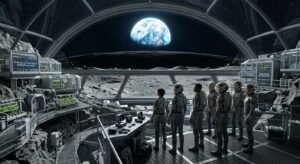
If humans eventually establish permanent settlements away from Earth, future generations could grow up in environments with different gravity, radiation levels, day-night cycles, and atmospheric conditions.
Mars has only about 38% of Earth’s surface gravity.
The Moon has even lower gravity.
We do not yet know what generations of human reproduction and development in such environments would ultimately produce.
Long-term exposure to reduced gravity could potentially affect bones, muscles, circulation, and development.
If future space populations became isolated from Earth for many generations, evolutionary divergence could eventually become possible.
But this would probably take much longer than a century.
Could Humans Become Partly Technological?
This may be more plausible than dramatic natural biological evolution.
Humans are already using technology directly with their bodies.
Pacemakers regulate heart rhythms.
Cochlear implants can provide a form of hearing to some people with severe hearing loss.
Prosthetic limbs can replace lost physical functions.
Brain-computer interfaces are being researched to allow neural signals to interact with computers and machines.
Future technologies could become more sophisticated.
People might eventually use artificial organs, advanced prosthetics, neural interfaces, or other devices that extend biological capabilities.
At that point, the question “What will humans look like?” might become less straightforward.
Some people could remain almost entirely biological.
Others might use increasingly advanced technologies.
Human variation could therefore include not only genetic differences but also technological differences.
Will Humans Become More Attractive?
There is no scientific way to predict what future humans will consider attractive.
Beauty standards are heavily influenced by culture.
What one society considers attractive can differ significantly from another society or historical period.
Evolutionary preferences may influence some aspects of mate selection, but culture, technology, media, social structures, and personal preferences also matter.
Future humans could therefore have very different ideas about beauty without needing major biological changes.
Could Humans Live Much Longer?
Lifespan is another area where technology could affect the future.
Advances in medicine may allow people to survive diseases and conditions that were once fatal.
Researchers are also studying aging biology, regenerative medicine, artificial organs, and other approaches that could influence healthspan.
If people live longer and remain healthy for longer, this could indirectly affect evolution by changing reproductive patterns and the age structure of populations.
However, longer lifespan does not automatically mean humans will evolve to live longer.
That would depend on whether genetic variants associated with longevity become more common through reproduction.
Medical technology and evolutionary change are different processes.
What Will Humans Look Like in 2126?
The most scientifically reasonable prediction is probably this:
Humans in 2126 will still look recognizably human.
We should not expect everyone to suddenly develop giant eyes, enormous brains, tails, or completely new body shapes.
A century is relatively short on an evolutionary timescale.
However, subtle changes could occur.
Average height could shift.
The distribution of certain genetic traits could change.
Some populations could become more genetically mixed.
Disease resistance could evolve in response to changing environments.
And technological developments could dramatically change how humans live and interact with their bodies.
The biggest changes may therefore not be visible in the mirror.
The Future of Human Evolution May Be Different From the Past
For most of human history, evolution happened without humans understanding the process.
Today, we understand genetics, reproduction, disease, and molecular biology at an unprecedented level.
That gives humans something previous species never had:
the ability to intentionally influence their own biology.
This does not mean humans will completely control evolution.
Biology is enormously complicated, and unintended consequences are always possible.
But technologies such as gene editing, reproductive medicine, regenerative medicine, artificial organs, and brain-computer interfaces could increasingly influence the relationship between humans and evolution.
The future may therefore involve two forms of change happening simultaneously.
Natural evolutionary processes will continue.
At the same time, human technology will increasingly modify the environments and biological systems in which those processes occur.