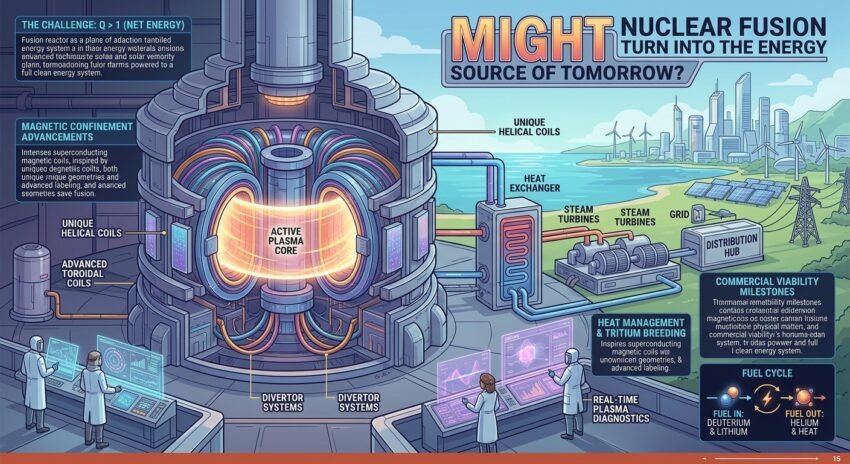
Might Nuclear Fusion Turn Into the Energy Source of Tomorrow?
Picture an energy source capable of generating vast amounts of power without burning coal, oil, or natural gas.Picture a fuel that exists abundantly in nature, a reaction that emits no carbon dioxide while fusing, and a power system incapable of the kind of runaway chain reaction seen in conventional nuclear fission reactors.
This may sound like science fiction.
Yet scientists have been pursuing it for many decades.
The technology is known nuclear fusion, and it is essentially the same process that powers the Sun.
Fusion might one day offer a new source of electricity for a world that requires ever-growing amounts of energy. It could power industries, cities, transportation, data centers, and technologies that demand huge quantities of electricity.
Still, a major obstacle stands in the way.
Producing fusion reactions on Earth is achievable. Building a fusion power plant that continuously yields more usable energy than the whole system consumes, runs dependably, and delivers electricity at a reasonable cost is far more difficult.
So, could nuclear fusion genuinely become one of the leading energy sources of the future?
To grasp the answer, we must first grasp what fusion truly is.
What Exactly Is Nuclear Fusion?
Nuclear fusion takes place when two light atomic nuclei merge into a single heavier nucleus.
This process is capable of releasing an immense amount of energy.
The Sun generates its energy by means of nuclear fusion. Deep within the Sun, immense pressure and extraordinarily high temperatures enable hydrogen nuclei to undergo fusion reactions.
On Earth, scientists are chiefly interested in a reaction involving two forms of hydrogen known as deuterium and tritium.
When these nuclei fuse, they yield helium, a neutron, and energy.
The energy produced by a single reaction is minuscule, yet countless reactions happening all the time can generate a considerable amount of power.
This is the core principle underlying a fusion reactor.
Why Is Fusion So Difficult?
The nuclei taking part in fusion carry a positive charge.
Since electric charges of the same kind push each other apart, two hydrogen nuclei naturally repel one another.
For them to fuse, scientists need to supply the nuclei with enough energy to get past this repulsion.
That calls for exceptionally high temperatures.
In experimental fusion systems, temperatures may climb to tens or even hundreds of millions of degrees Celsius.
Under such conditions, matter turns into a state known as plasma.
Plasma is frequently referred to as the fourth state of matter, together with solids, liquids, and gases.
The difficulty here is clear.
How can you hold something hotter than the Sun’s core without letting it come into contact with the walls of the machine?
Researchers have come up with a number of methods to address this issue.
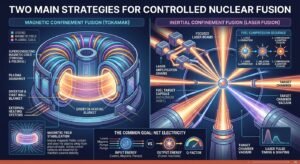
A commercial power plant would need to generate energy repeatedly and efficiently.
Where Would Fusion Fuel Come From?
One reason fusion is appealing is that some of its fuel sources are fairly plentiful.
Deuterium is found naturally in seawater.
Tritium is significantly rarer and radioactive, meaning a practical deuterium-tritium fusion power system would require a way to produce or “breed” tritium within the reactor.
This is anticipated to require materials that contain lithium.
The fusion reaction generates high-energy neutrons, and reactor designs may be able to use these neutrons to assist in producing new tritium from lithium.
This presents a significant engineering challenge.
A commercial fusion reactor would need not only to sustain the plasma but also to handle fuel production, neutron energy, heat, materials, and radioactive components.
Why Fusion Produces So Much Energy ?
Fusion releases energy because the reaction’s products have slightly less mass than the original nuclei.
The missing mass is turned into energy in accordance with Einstein’s famous relationship between mass and energy.
Even a tiny amount of mass can correspond to an enormous amount of energy.
This is one reason nuclear reactions can yield vastly more energy per unit of fuel than ordinary chemical combustion.
Burning coal or natural gas rearranges chemical bonds.
Fusion alters the nuclei themselves.
The energy scales are therefore dramatically different. Could Fusion Replace Fossil Fuels?
In principle, fusion could become a significant low-carbon energy source, but it is too soon to claim it will fully replace fossil fuels.
A future energy system will probably include many technologies.
Solar and wind power can supply large quantities of electricity.
Hydropower, geothermal energy, nuclear fission, energy storage, and other technologies can also play a part.
Fusion could become another major source if scientists and engineers resolve the remaining technical and economic challenges.
One notably interesting aspect is that fusion power plants might be able to deliver a steady supply of electricity instead of relying directly on sunlight or wind conditions.
This could make them valuable as a component of a broader electricity system.
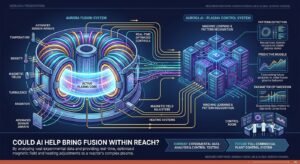
Could AI Help Bring Fusion Within Reach?.
What Makes Fusion Different From Nuclear Fission?
Nuclear fission is the technology behind today’s conventional nuclear power plants.
Fission breaks heavy atomic nuclei, such as uranium, into smaller nuclei and releases energy.
Fusion does the reverse.
It merges light nuclei into a heavier nucleus.
There are also significant differences in how the reactions behave.
A fusion plasma needs very specific conditions in order to keep going.
Should those conditions be lost, the fusion reaction drops off quickly.
As a result, a fusion reactor does not run on the same kind of self-sustaining chain reaction that a fission reactor uses.
Yet this does not mean that fusion poses no safety challenges.
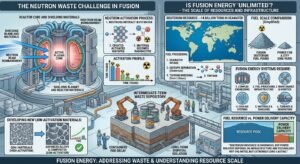
A fusion facility would still hold radioactive materials, among them tritium and materials made radioactive by neutron exposure.
The reactor would require careful engineering, shielding, monitoring, maintenance, and waste management.
Might Fusion Bring Down the Cost of Electricity?
Among the largest questions still without an answer is this one.
A fusion reactor would be a machine of remarkable complexity.
It would need strong magnets, purpose-built materials, heating systems, vacuum apparatus, cooling equipment, fuel handling, radiation shielding, and sophisticated control systems.
Building and maintaining all of that would come at a high cost.
So simply generating fusion energy is not sufficient.
For a fusion plant to be commercial, the electricity it produces must be priced competitively against other energy sources.
Even a tiny amount of mass can correspond to an enormous amount of energy.
That means scientists and enEven a tiny amount of mass can correspond to an enormous amount of energy.gineers have to tackle both the **physics problem** and the **engineering economics problem**.
A reactor that functions scientifically but is too costly to construct might never become a major commercial technology.
What Are the Biggest Challenges That Remain?
A number of significant obstacles remain before fusion can move from the experimental stage to commercial power generation.
1. Keeping Plasma Stable
For extended periods, the plasma has to stay hot and under control.
2. Generating More Usable Energy
A viable power plant needs to generate considerably more usable energy than the entire facility uses.
3. Withstanding Neutron Damage
The materials enclosing the plasma must endure heavy bombardment from high-energy neutrons.
4. Generating Tritium
A deuterium-tritium reactor would require a dependable system to produce and recover tritium.
5. Servicing the Reactor
Components inside the reactor could face extreme thermal and radiation stress.
Engineers require methods to inspect, repair, and swap out components, possibly with the help of remote robotic systems.
6. Lowering Costs
In the end, a fusion reactor has to become economically competitive with other sources of electricity.
Addressing all six issues at once stands as one of the most significant engineering hurdles in contemporary energy research.
When Could Fusion Power Become Commercial?
No single dependable date exists for when fusion will turn into a major commercial energy source.
Researchers along with private companies are working on various reactor designs and schedules.
Certain projects intend to show increasingly powerful fusion systems over the coming years and decades.
However, proving fusion energy through an experiment differs from running a commercial power plant.
A commercial plant would have to generate electricity dependably, consistently, safely, and affordably.
As a result, fusion’s progress is best seen as a sequence of milestones instead of a single final breakthrough.
The first step is controlled fusion.
After that comes sustained operation.
Next is energy production.
Following that is reliable electricity generation.
Then comes commercial economics.
Every stage brings its own new challenges.
Could Fusion Change Civilization?
Should commercial fusion become viable, its impact could reach well beyond electricity.
Plentiful low-carbon electricity could potentially sustain energy-intensive industries.
It could assist in powering large-scale water desalination.
It could aid the production of hydrogen and synthetic fuels.
It could supply electricity for data centers and advanced computing.
It might be able to make energy-intensive industrial processes simpler to decarbonize.
In nations with scarce renewable-energy resources, fusion may one day offer an additional option for dependable electricity generation.
The outcomes would hinge on the technology’s eventual cost, scale, and speed of deployment.
Could Fusion Power Space Exploration?
Fusion might also hold significance beyond Earth.
Spacecraft need vast amounts of energy to travel quickly through the Solar System.
Chemical rockets are incredibly powerful, yet they carry huge quantities of propellant.
If practical fusion propulsion were ever developed, spacecraft might be able to reach far higher performance than many conventional propulsion systems.
This could make missions to distant planets and other destinations more achievable.
Yet fusion propulsion poses an engineering challenge distinct from generating electricity through fusion.
A fusion reactor that generates electricity on Earth does not automatically turn into a spacecraft engine.
Scientists would have to tackle further issues involving mass, heat rejection, shielding, thrust, and reactor design.
Even so, this possibility is one reason fusion draws attention well beyond the energy sector.
Will Fusion Really Become the Energy Source of the Future?
Fusion possesses something rare in science and engineering: immense potential paired with immense difficulty.
The underlying physics is well understood.
Scientists know that fusion works.
The Sun shows that nature can maintain fusion reactions for billions of years.
Researchers have likewise demonstrated controlled fusion reactions in laboratories.
What remains is the challenge of converting these scientific achievements into a practical power plant.
This requires building a machine capable of continuously sustaining fusion conditions, enduring extreme environments, capturing the energy produced, generating its own fuel when needed, and delivering electricity at a cost that is economically viable.
There is no guarantee that all proposed fusion designs will be successful.
Yet research presses on, since the possible advantages are considerable.
The Future of Energy May Not Have One Winner
Even if fusion achieves commercial success, it likely will not remove all other forms of energy production.
Tomorrow’s electricity system might include a blend of technologies.
Solar panels could supply electricity during periods of sunshine.
Wind farms could add power when conditions are suitable.
Batteries and other storage technologies could smooth out fluctuations.
Hydropower could offer flexibility.
Existing and future fission reactors could deliver steady electricity.
And fusion might become yet another source of high-density, continuous power.
The energy system of tomorrow may thus be more varied rather than controlled by a single technology.
Could nuclear fusion become the energy source of the future?
It could play a significant role in the future energy system, yet scientists have not yet shown a commercially viable fusion power plant.
Fusion presents several potentially appealing traits: extremely high energy density, possibly plentiful fuel resources, no carbon dioxide generated by the fusion reaction itself, and a reaction that halts naturally once the necessary plasma conditions are lost.
Meanwhile, fusion confronts immense obstacles involving plasma stability, reactor materials, tritium production, heat management, maintenance, engineering complexity, and cost.
The coming decades will show whether scientists can turn fusion from an impressive laboratory feat into a dependable source of electricity.
If they manage it, the effects could be tremendous.
Humanity might obtain a potent new method of generating energy that does not depend on fossil fuels.
However, the genuine breakthrough will not occur merely because scientists manage to make fusion happen.
The actual breakthrough will arrive once they can make fusion operate dependably, repeatedly, affordably, and on the scale that modern civilization demands.
This is the obstacle that may decide whether nuclear fusion turns into one of the key energy technologies of tomorrow.