The Enigmatic Signals Emanating From Far Below the Ocean
The deep ocean is one of the least explored environments on Earth. Beneath the surface, thousands of meters of water separate scientists from a world of darkness, extreme pressure, freezing temperatures, volcanic activity, and unusual forms of life. Although modern technology has allowed researchers to explore parts of the seafloor, much of the deep ocean remains poorly understood.
One of the most fascinating discoveries in recent ocean science has been the detection of strange sounds and signals originating from deep beneath the ocean surface. Some are produced by earthquakes, volcanic activity, underwater landslides, ice movement, and marine animals. Others are much harder to identify. Scientists have recorded extremely low-frequency sounds traveling enormous distances through the ocean, creating mysteries that can take years to solve.
These underwater signals are not necessarily evidence of something unknown or artificial. In most cases, scientists eventually connect mysterious sounds to natural processes. However, every unexplained signal provides an opportunity to learn something new about Earth’s oceans.
Why Can the Ocean Produce Such Strange Signals?
Water is an excellent medium for transmitting sound. Unlike light, which is quickly absorbed by seawater, sound can travel thousands of kilometers under the right conditions.
The ocean also contains different layers of water with different temperatures, pressures, and densities. These differences can bend sound waves and create underwater pathways through which sound can travel long distances.
One important phenomenon is known as the SOFAR channel, or Sound Fixing and Ranging channel. At certain depths, sound can become trapped between layers of water and travel enormous distances with relatively little energy loss.
This means that a sound generated thousands of kilometers away can sometimes be detected by instruments in another part of the ocean.
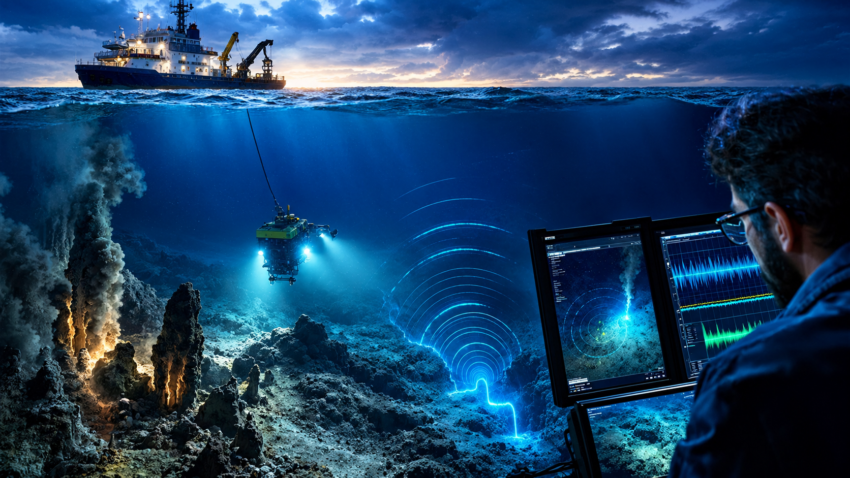
Researchers use specialized underwater microphones called hydrophones to listen to these signals. Hydrophones can detect sounds that human ears cannot hear, including extremely low-frequency acoustic waves.
By comparing signals recorded by multiple hydrophones, scientists can estimate where a sound originated and sometimes determine what caused it.
The Discovery of Deep Ocean Signals
The scientific discovery of mysterious underwater signals did not happen through a single event. Instead, researchers gradually developed networks of instruments capable of listening to the ocean continuously.
During the twentieth century, scientists and military organizations began deploying underwater microphones to monitor sounds beneath the sea. One major purpose was detecting submarines, but researchers soon realized that the same instruments could reveal enormous amounts of information about the natural environment.
Scientists discovered that the ocean was filled with sounds.
Earthquakes created powerful acoustic waves. Underwater volcanic eruptions generated intense signals. Icebergs produced unusual noises as they fractured and moved. Marine animals communicated with sounds that could travel surprisingly far.
Some signals were initially difficult to identify because they were outside the range of normal human hearing or occurred in environments that scientists could not directly observe.
The development of global hydrophone networks dramatically expanded this research.
One of the best-known monitoring systems is the International Monitoring System, developed as part of the Comprehensive Nuclear-Test-Ban Treaty monitoring framework. Its underwater stations are capable of detecting very low-frequency acoustic signals traveling through the world’s oceans.
These instruments have contributed to the identification of natural events as well as human-generated activity.
The Famous Bloop Mystery
One of the most famous examples of a mysterious underwater sound is the signal popularly known as the bloop.
In 1997, underwater sensors detected an extremely powerful, ultra-low-frequency sound in the Pacific Ocean. The signal was so unusual that it attracted considerable public attention.
Because the sound was extraordinarily powerful, some people proposed imaginative explanations, including the possibility that it came from a previously unknown gigantic marine creature.
However, scientific analysis eventually provided a much more realistic explanation.
Researchers concluded that the characteristics of the signal were consistent with a large ice-related event, such as the cracking or fracturing of an iceberg or ice shelf.
This case demonstrates an important principle in science: an unexplained observation is not automatically evidence of an extraordinary discovery.
A strange signal may initially seem mysterious because scientists do not yet know its source. As more data become available, the mystery can often be solved using physics, geology, and oceanography.
Signals Created by Underwater Earthquakes
One of the most important sources of deep-ocean signals is seismic activity.
When tectonic plates move beneath the ocean, enormous amounts of energy can be released. Earthquakes generate seismic waves that travel through the Earth’s crust and surrounding water.
Large underwater earthquakes can produce acoustic signals detectable over enormous distances.
These signals are scientifically valuable because they can help researchers understand what is happening beneath the seafloor.
The ocean covers more than 70 percent of Earth’s surface, but scientists cannot easily place conventional instruments everywhere. Hydrophones therefore provide another method of monitoring geological activity.
By analyzing the timing and characteristics of underwater acoustic signals, researchers can sometimes identify earthquakes and estimate their locations.
This is particularly important for studying regions where tectonic plates collide.
The Hidden Sounds of Underwater Volcanoes
The ocean floor contains thousands of volcanoes, many of which are located far from land.
Some underwater volcanoes are continuously active, while others erupt periodically. Their activity can generate powerful acoustic signals.
During an eruption, magma and gases interact with seawater. The sudden release of heat and pressure can create bubbles, explosions, and vibrations.
These events produce distinctive acoustic patterns.
Scientists can use hydrophones to monitor volcanic regions even when they are too deep or dangerous for direct observation.
This gives researchers a way to study volcanic processes without placing scientists directly above an active eruption.
In some cases, acoustic monitoring can even reveal volcanic activity that would otherwise remain unnoticed.
Could the Signals Come From Unknown Animals?
The idea of unknown creatures producing mysterious ocean sounds is extremely popular.
The deep ocean certainly contains species that have never been scientifically described. Scientists continue to discover new organisms, particularly in deep-sea environments around hydrothermal vents, seamounts, and underwater caves.
Marine animals also produce an extraordinary variety of sounds.
Whales are perhaps the best-known example. Some whale calls can travel hundreds of kilometers through the ocean. Sperm whales produce powerful clicks, while other whales generate complex low-frequency calls.
Fish, crustaceans, and other marine organisms also create sounds through movement, communication, feeding, or interactions with their environment.
However, scientists must be careful before attributing an unknown signal to an unknown animal.
A signal’s frequency, intensity, duration, repetition pattern, and location all have to be examined.
An unusually powerful sound would require a plausible physical mechanism. Therefore, the existence of undiscovered marine species does not automatically explain every mysterious underwater signal.
Hydrothermal Vents: Another Source of Mystery
One of the most extraordinary environments in the deep ocean is the hydrothermal vent system.
Hydrothermal vents form where seawater interacts with extremely hot geological material beneath the seafloor.
Water can penetrate cracks in the ocean crust, become heated by magma, and return to the seafloor carrying dissolved minerals.
When this hot water reaches the cold surrounding ocean, minerals can precipitate and form chimney-like structures.
These locations can support entire ecosystems despite the absence of sunlight.
Instead of depending directly on photosynthesis, many organisms living near hydrothermal vents depend on chemosynthesis.
Specialized microorganisms use chemical energy to produce organic matter.
The discovery of these ecosystems transformed scientists’ understanding of where life can exist.
It also raised a major question: if life can survive under extreme conditions on Earth, could similar environments exist elsewhere in the solar system?
What Scientists Actually Do When They Detect a Mystery Signal
When researchers detect an unusual underwater signal, they do not immediately assign a dramatic explanation.
The first step is usually to examine the data carefully.
Scientists ask several questions:
When did the signal occur?
The exact timing can help determine whether it coincided with a known earthquake, volcanic event, storm, iceberg movement, or other phenomenon.
Where did it originate?
If multiple hydrophones detect the same signal at different times, scientists can compare those recordings to estimate its source.
What frequencies does it contain?
Different physical processes produce different acoustic patterns. Frequency analysis can therefore provide clues about the source.
How powerful is the signal?
The strength of a signal can help scientists estimate the scale of the event that produced it.
Does the signal repeat?
Repeated patterns may suggest biological activity, machinery, or ongoing geological processes.
Researchers can also compare a mysterious signal with recordings from previously identified events.
This process allows scientists to gradually eliminate possible explanations.
The Role of Artificial Intelligence
Modern ocean research is producing enormous amounts of acoustic data.
Hydrophones can operate continuously, recording sounds day and night. A single instrument can generate huge datasets over long periods.
Human researchers cannot manually examine every recording.
Artificial intelligence and machine-learning systems are therefore becoming increasingly important.
Scientists can train algorithms to recognize patterns associated with earthquakes, marine mammals, ships, volcanic activity, and other known sources.
When an unusual signal appears, automated systems can flag it for further investigation.
This does not mean that artificial intelligence automatically solves the mystery. Instead, it helps researchers identify interesting signals much faster.
AI may become particularly valuable as underwater monitoring networks expand.
Discovery: What Could Future Researchers Find?
The greatest discovery may not be a mysterious monster or an artificial structure.
It may be a better understanding of Earth’s hidden processes.
The deep ocean contains information about climate, geology, biology, and the history of our planet.
For example, acoustic observations can help researchers study:
- underwater earthquakes
- volcanic eruptions
- submarine landslides
- melting and movement of ice
- whale populations
- deep-sea ecosystems
- ocean circulation
- human activity
- changes in marine environments
Future instruments could become even more sensitive.
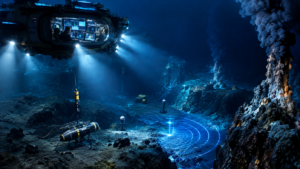
Autonomous underwater vehicles may be able to travel into regions that are currently difficult to investigate. These vehicles could carry hydrophones, cameras, chemical sensors, and other scientific equipment.
Scientists may eventually create three-dimensional acoustic maps of large portions of the deep ocean.
Such maps could reveal geological structures and biological activity that are currently hidden.
Could There Be Signals We Have Not Yet Understood?
Yes.
The ocean is an extraordinarily complicated acoustic environment. Multiple sounds can overlap, reflect from the seafloor, travel through different water layers, and change as environmental conditions vary.
Some signals may remain unexplained simply because scientists do not have enough information.
This does not mean that they are supernatural or extraterrestrial.
In science, an unexplained observation is an invitation to investigate rather than a conclusion.
History provides many examples of phenomena that initially appeared mysterious but were eventually explained through improved measurements and better scientific models.
The same may happen with future underwater signals.
Why This Research Matters
Understanding underwater sound is not simply about solving interesting mysteries.
It has practical importance.
Earthquakes and submarine landslides can generate dangerous tsunamis. Improved monitoring could help scientists understand these events and improve warning systems.
Acoustic monitoring can also help researchers study marine mammals and understand how human activities affect underwater ecosystems.
Shipping, industrial operations, and other human activities can introduce large amounts of noise into the marine environment.
Scientists are studying whether this increasing underwater noise affects animals that depend heavily on sound for communication, navigation, hunting, and reproduction.
Therefore, the mysterious signals beneath the ocean may provide information about both natural processes and the effects of human activity.
The Deep Ocean Remains a Scientific Frontier
Despite decades of exploration, humans have directly observed only a fraction of the deep seafloor.
The difficulty is obvious. At great depths, pressure becomes enormous, temperatures can be extremely low, and sunlight disappears completely.
Sending humans into such environments is expensive and dangerous.
Listening, however, provides another method.
Scientists do not always need to physically see an event to study it. Acoustic signals can act as fingerprints of processes occurring thousands of meters below the surface.
An earthquake, volcanic eruption, iceberg fracture, or animal can leave behind a distinctive acoustic signature.
By learning to interpret these signatures, researchers can investigate places that are otherwise extremely difficult to reach.