Researchers Have Discovered a Location Where Time Acts Differently
Time appears to be among the most dependable aspects of our existence.
Each second appears to tick by at precisely the same speed. Sixty seconds make a minute, sixty minutes make an hour, and a day consists of 24 hours. No matter where we travel, we assume clocks will match. However, the universe does not operate in that manner.
More than a century ago, Albert Einstein predicted something that sounded almost impossible:
time does not pass at exactly the same rate everywhere.
Gravity can change the rate at which time passes, and motion can change it too.
Today, scientists have repeatedly measured this strange effect with incredibly precise clocks.
In fact, researchers have reached a point where they can detect differences in the passage of time between clocks separated by surprisingly small distances.
This means that the phrase “time behaves differently” is not simply science fiction.
It is a measurable property of our universe.
Time Is Not the Same Everywhere
Our everyday experience makes time appear universal.
If two people synchronize their watches and one person stays at home while the other travels somewhere else, both expect their watches to remain synchronized.
But Einstein’s theory of relativity tells us that this assumption is not completely correct.
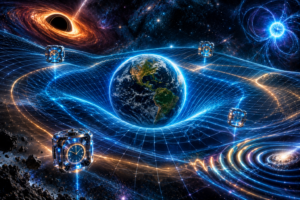
According to general relativity, gravity affects the passage of time.
A clock positioned nearer to a massive body feels stronger gravitational effects and therefore ticks a bit more slowly than a clock located farther off.
This effect is referred to as gravitational time dilation.
The difference is usually incredibly small.
You would not notice it by looking at two ordinary clocks.
But modern atomic clocks are so accurate that scientists can detect these tiny differences.
And this has created an extraordinary situation: two clocks sitting at different elevations can measure slightly different amounts of elapsed time.
The clock lower down is experiencing slightly stronger gravity, so it runs a little slower.
The clock higher up runs slightly faster.
It sounds strange, but experiments have demonstrated it.
The Mountain Clock That Ages Differently
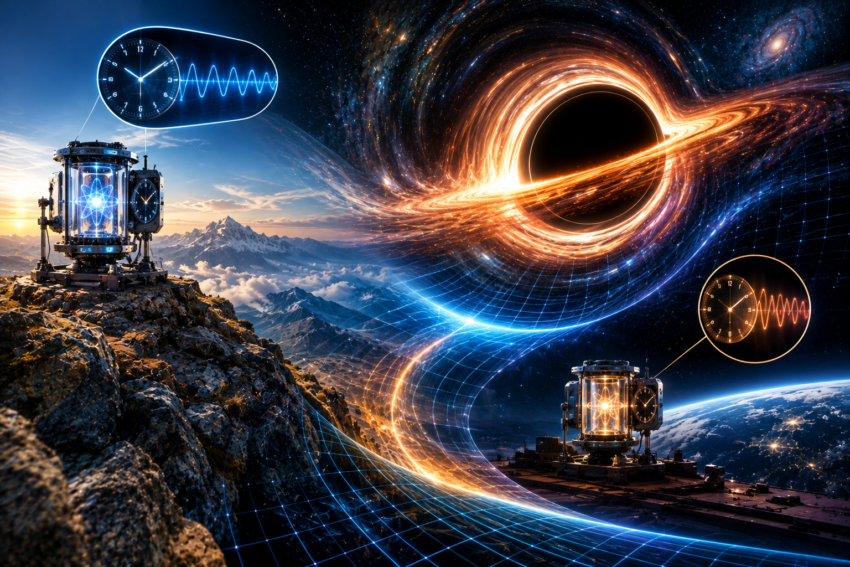
Imagine placing one extremely precise clock at the bottom of a mountain and another at the top.
The clock at the top is slightly farther from Earth’s center.
Because Earth’s gravitational field is marginally weaker there, time passes slightly faster for the higher clock.
The difference is tiny.
You would never notice it during a normal human lifetime.
But an atomic clock can measure it.
This is among the reasons contemporary physics has reshaped the way we understand time.
Time is not merely a universal backdrop that ticks along on its own, separate from everything else.
Rather, time is linked to space, gravity, motion, and the very structure of the universe.
Scientists Can Measure Time Differences Across Tiny Heights
One of the most remarkable developments in modern physics is the increasing sensitivity of atomic clocks.
Older experiments needed clocks separated by significant distances to detect gravitational time dilation.
Modern optical clocks are vastly more precise.
Scientists can use them to investigate how time changes across relatively small differences in height.
At sufficiently high precision, even moving a clock upward by a small distance can produce a measurable change in its ticking rate.
This turns time into a kind of scientific measuring tool.
Rather than just asking, “What time is it?”
Researchers are able to ask:
What is the strength of gravity in this location?
How far above Earth’s surface is this clock located?
In what ways does the gravitational field vary throughout this area?
In this sense, extremely precise clocks can function almost like gravity sensors.
What Happens Near a Black Hole?
If the effects of gravity on time are fascinating on Earth, they become far more dramatic around extremely massive objects.
One of the most extreme examples is a black hole.
A black hole contains an enormous amount of mass concentrated into an incredibly compact region. Its gravitational field can become so strong that even light cannot escape once it crosses the event horizon.
According to general relativity, the stronger the gravitational field, the greater the effect on the passage of time relative to a distant observer.
This creates one of the strangest predictions in modern physics.
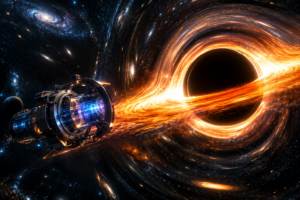
Imagine an astronaut traveling toward a black hole while another observer remains extremely far away.
As far as the astronaut is concerned, time would keep passing as usual. Their watch would seem to tick at a normal rate, and the trip would feel entirely ordinary to them.
However, from the faraway observer’s viewpoint, the astronaut’s clock would seem to slow down more and more as the astronaut gets closer to the black hole’s event horizon.
The difference comes from the way space and time are affected by extreme gravity.
This doesn’t imply that the astronaut all at once senses time slowing down.
What it means is that different observers may measure the passage of time differently, since they are subject to different gravitational conditions.
Does Time Actually Stop?
This is where popular descriptions can become misleading.
You may have heard that “time stops at a black hole.”
That statement is an oversimplification.
For someone falling toward a black hole, their own proper time continues normally as they move through their local environment.
The apparent slowing of their clock to a distant observer is a consequence of the geometry of spacetime and the way information travels out of the strong gravitational field.
So there is no universal cosmic clock that suddenly freezes.
Instead, different observers can experience and measure time differently.
This stands as one of the core lessons of relativity.
The GPS System Relies on Time Dilation
Perhaps the most remarkable thing is that relativistic time effects aren’t merely theoretical ideas connected to black holes. They affect the technology we depend on every day. Global Positioning System satellites circle Earth at significant altitudes and travel at high speeds. Their clocks undergo two key relativistic effects.
Firstly, since satellites are farther from Earth’s center, they encounter marginally weaker gravity than clocks located on the ground. As a result of gravitational time dilation, their clocks run faster.
Secondly, since satellites move quickly relative to observers on Earth, special relativity makes their clocks run a bit slower.
These effects work in opposite directions.
The gravitational effect is larger than the velocity effect for GPS satellites, so their clocks would gradually become offset from clocks on Earth if engineers did not account for relativity.
A timing error, no matter how slight, can result in a considerable positioning error.
This means that the location services relied upon by smartphones, vehicles, aircraft, ships, and numerous other systems hinge on our grasp of how time behaves.
Relativity is far more than an abstract theory.
It plays a role in modern technology.
Why Atomic Clocks Are So Important
To grasp how scientists identify these effects, we must examine atomic clocks.
An atomic clock doesn’t keep time with a mechanical spring or a conventional swinging pendulum.
Rather, it depends on highly stable transitions between the energy states of atoms.
Some atoms are able to act as exceptionally reliable natural oscillators.
By measuring these transitions with electromagnetic radiation, scientists can construct clocks of extraordinary precision.
Contemporary optical clocks operate at frequencies significantly greater than those of conventional microwave atomic clocks.
This elevated frequency offers more chances to gauge oscillations with precision, enabling scientists to construct clocks of remarkable stability and accuracy.
These instruments have become so sensitive that tiny changes in gravitational potential can become measurable.
The result is a new kind of science in which time itself becomes a measurement instrument.
A Clock Can Reveal the Shape of Gravity
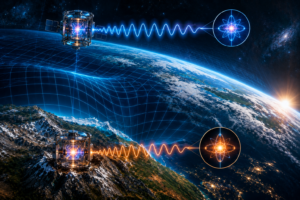
Imagine two extremely precise clocks placed in different locations.
If one clock runs slightly faster than the other, scientists can use that difference to learn something about the gravitational environment.
This creates a fascinating possibility.
Instead of measuring Earth’s gravitational field only through traditional instruments, researchers can also use clocks.
A network of ultra-precise clocks could potentially help scientists monitor changes in Earth’s surface and underground structures.
For example, variations in elevation, geological activity, underground water movement, or other changes in gravitational potential could potentially leave tiny signatures in precision time measurements.
The technology is still developing, but the concept is revolutionary.
A clock is no longer simply a device that tells us when to have lunch.
It can become a scientific sensor.
Time Changes With Motion Too
Gravity is not the only thing that changes the passage of time.
Motion does as well.
According to Einstein’s special theory of relativity, a clock in motion runs more slowly compared to an observer who sees that clock moving at high speed.
This phenomenon is referred to as time dilation caused by velocity.
Again, the effect is extremely small at everyday speeds.
If you drive your car to the grocery store, the difference between your elapsed time and that of someone who stayed home is far too small to notice.
But as speeds approach the speed of light, the effect becomes dramatic.
This creates one of the most famous consequences of relativity.
A traveler moving at extremely high speed could experience less elapsed time than people who remained behind.
This is sometimes called the “twin paradox.”
It does not mean the traveler has discovered a way to reverse time.
Instead, the traveler and the person who stayed behind can experience different amounts of elapsed time between the same general beginning and ending events.
Could Humans Use Time Dilation to Travel Into the Future?
In a way, we already have the answer.
Yes.
According to relativity, someone moving at very high speeds experiences less time than those who stay relatively still.
Imagine a spacecraft capable of traveling at a speed very near the speed of light.
The astronauts might live through only a few years, while far more years went by for those on Earth.
Upon their return, they would in effect have journeyed into Earth’s future.
The challenge is enormous.
Current spacecraft are nowhere near the speed of light.
The energy required to accelerate a massive spacecraft to relativistic speeds would be extraordinary, and there are major engineering challenges involving propulsion, radiation, collisions with tiny particles, and keeping humans alive during extremely long missions.
So relativistic time travel into the future is physically possible according to our current understanding of physics, but technologically far beyond our present capabilities.
Is There a Place Where Time Passes Fastest?
There is no single universal location that can simply be called “the fastest time.”
Time is influenced by how an observer moves and by the gravitational conditions around them.
A clock positioned farther from a massive object typically undergoes less gravitational time dilation, and as a result it ticks faster compared with a clock located deeper within the gravitational field.
However, movement can lead to the reverse outcome.
This means determining which clock runs faster requires knowing the entire physical situation.
On Earth, differences are extremely small.
Near a neutron star or black hole, however, the effects can become enormous.
A neutron star packs more mass than the Sun into an object only roughly the size of a city.
Its gravitational field is vastly stronger than Earth’s.
Near such an object, clocks can behave very differently compared with clocks far away.
Why This Discovery Matters
At first glance, time dilation might seem like an interesting but impractical scientific curiosity.
It is much more than that.
Understanding time is essential for satellite navigation, telecommunications, astronomy, particle physics, and precision measurement.
Relativity also gives scientists a framework for understanding some of the most extreme environments in the universe.
Black holes, neutron stars, gravitational waves, expanding space, and the behavior of light are all connected to our understanding of spacetime.
The better scientists can measure time, the better they can test these theories.
And every improvement in clock technology gives researchers a more precise window into the universe.
Could We Eventually Map Gravity With Clocks?
This is one of the most exciting possibilities.
Imagine thousands of extremely accurate clocks distributed around Earth.
Each clock continuously compares its measurement of time with neighboring clocks.
Tiny differences could reveal information about the gravitational field across the planet.
Such a system could potentially provide a new method of observing geological changes.
Scientists could investigate variations caused by shifting masses, changing water reservoirs, tectonic activity, and other processes.
Instead of seeing time merely as a measurement of change, researchers could use changes in time itself to study the Earth.
This represents a profound shift in how we think about clocks.
The Universe Has No Single Master Clock
Perhaps the biggest lesson from these discoveries is that our everyday idea of time is incomplete.
We grow up believing that time is something universal.
Everyone experiences the same seconds.
Every clock should ultimately agree.
But Einstein showed that the universe has no simple master clock controlling everything.
Time is woven together with space.
Gravity bends spacetime.
Motion changes how different observers measure elapsed time.
Two clocks can begin together, travel through different environments, and later disagree about how much time has passed.
Neither clock necessarily has to be “wrong.”
They have simply followed different paths through spacetime.
This is one of the strangest and most beautiful discoveries in modern science.
The Future of Time Research
Scientists continue to develop clocks that are more precise than anything previous generations could have imagined.
Optical clocks, quantum technologies, and new methods of frequency measurement are pushing the boundaries of precision.
As clocks improve, researchers may be able to test Einstein’s theories at increasingly sensitive levels.
They may also discover unexpected effects.
Perhaps precision clocks will help detect subtle gravitational phenomena.
Perhaps they will improve our understanding of Earth’s interior.
Perhaps networks of clocks will become important tools for space exploration.
And perhaps future experiments will reveal that our current understanding of time is only part of a deeper theory of physics.
Science has repeatedly shown that the universe becomes stranger when we look closely enough.
A Discovery That Changed Our Understanding of Reality
Scientists did not discover a hidden room somewhere in the universe where clocks mysteriously behave differently.
They discovered something far more profound.
Time itself is affected by the physical universe.
Gravity can change the rate at which clocks tick.
Motion can change the amount of time experienced by different observers.
Near extreme objects such as black holes, these effects become extraordinary.
And on Earth, advanced atomic clocks can now measure differences that would have been completely impossible to detect only a few generations ago.
The most remarkable part is that this strange behavior is not merely theoretical.
We can measure it.
We can calculate it.
We can build technology that depends on it.
And every time a GPS device determines your location, every time scientists compare ultra-precise clocks, and every time astronomers study a black hole, humanity is taking advantage of a reality that once seemed impossible:
Time is not the same everywhere.
The universe does not have one giant clock ticking at the same rate from beginning to end.
Instead, time is part of the fabric of reality itself—shaped by gravity, influenced by motion, and intimately connected to the structure of space.
The more precisely we measure it, the more surprising the universe becomes.
And perhaps the next great discovery will not be about finding a new place in space.
It may be about discovering something even stranger about time itself.